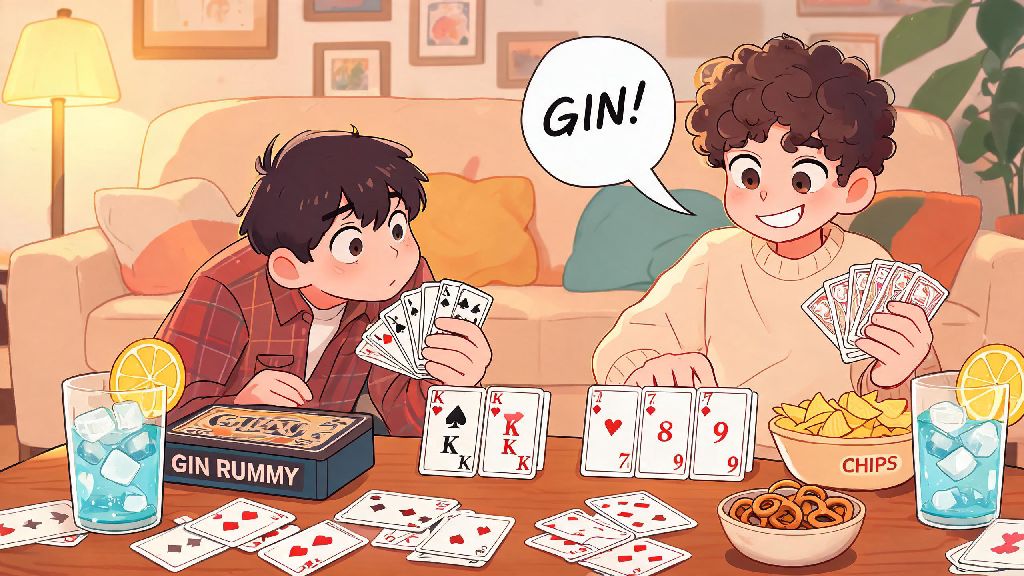
There’s a reason gin rummy has stuck around as one of the most beloved casual card games for more than a century. It’s fast enough to play during a 15-minute work break, strategic enough to keep you engaged for hours, and simple enough that almost anyone can pick up the basics in a single game. If you’ve ever sat down at a game night with a standard deck and wondered how do you play gin rummy, this guide breaks down every rule, step, and small trick you need to play your first round without feeling lost.
Core Rules to Understand Before You Learn How Do You Play Gin Rummy
First, let’s cover the basics that never change, no matter what house rules your group uses. Gin rummy is always a two-player game—any version with more than two people is a different rummy variant, not standard gin. You only need a standard 52-card deck, no jokers required.
The goal of every round is to arrange as many of your 10 cards as possible into valid melds, and reduce the total value of your un-melded cards (called deadwood) to 10 points or less. Melds come in two types: sets, which are 3 or 4 cards of the same rank (like three 8s, or four queens) and runs, which are 3 or more consecutive cards of the same suit (like 3,4,5 of spades).
Card values are straightforward: number cards are worth their face value, aces are worth 1 point, and all face cards (jacks, queens, kings) are worth 10 points each. Aces only count as low cards, so you can’t make a run of Q-K-A, no matter how badly you want to. I learned that the hard way during my first game with my grandpa, when I thought I had gin and lost the round because my “perfect” run was invalid.
Step-by-Step Gin Rummy Gameplay Flow for First-Time Players
Once you’ve got the core rules down, the actual gameplay is super simple. Start by choosing a dealer: you can draw for high card, or just flip a coin. The dealer deals 10 cards to each player, one at a time, face down. The remaining cards go in a face-down pile in the middle of the table called the stock. Flip the top card of the stock face up next to it to start the discard pile.
The non-dealer goes first. On every turn, you have two choices for drawing a card: you can take the top face-down card from the stock, or the top face-up card from the discard pile. After you draw a card, you have to discard one card from your hand face up on the discard pile. You can’t discard the same card you just picked up from the discard pile in the same turn, that’s considered a foul in most casual and competitive games.
Play continues back and forth until one player decides to knock, or the stock pile runs out. You can knock only when the total value of your deadwood is 10 points or less. When you knock, you lay all your melds face up on the table, along with your deadwood, to end the round. If you have no deadwood at all, that’s called gin, and you get an automatic bonus for the round. If you knock and your opponent has a lower deadwood total than you, you lose the round and pay the difference plus a 10-point penalty—that’s called an undercut, and it’s one of the most frustrating mistakes new players make.
Common Gin Rummy Scoring Rules to Avoid Costly Mistakes
Scoring is straightforward once you get the hang of it, but there are a few easy mistakes that can make you lose a game you thought you won. After a knock, both players lay down their melds, and the opponent can lay off any of their deadwood cards into the knocking player’s melds if they fit, to reduce their own deadwood total. For example, if you knocked with a set of three 7s, your opponent can add their fourth 7 to your set to get rid of that deadwood point.
If the knocking player has gin, they get a 25-point bonus plus the full total of the opponent’s deadwood, no layoffs allowed. If it’s a standard knock, the knocking player gets the difference between their deadwood total and the opponent’s, if theirs is lower. If the opponent undercuts them, the opponent gets the difference plus a 10-point bonus. The first player to hit 100 total points wins the full game, plus a 100-point game bonus, and 25 points for every round they won during the game.
Most new players mess up scoring at least once in their first few games. Watch out for these common errors:
Always count your deadwood twice before you knock—it only takes 10 seconds, and it can save you from losing a round you thought you had locked up. I once knocked with what I thought was 9 points of deadwood, only to realize I’d counted a queen as 5 points, and I had 14 total, which meant I lost the round and the whole game.
Simple Starter Strategies to Win More Gin Rummy Games
You don’t need to master super advanced strategies to win most casual gin rummy games. A few small, easy tricks will help you beat most new players, and hold your own against people who have been playing for years.
First, get rid of high-value un-melded cards early. Kings and queens are worth 10 points each, so if you’ve been holding a single queen for three turns and haven’t picked up another one or any cards that would make a run with it, discard it. Holding high deadwood makes it almost impossible to knock before your opponent, and it will cost you a lot of points if they get gin first.
Don’t pick up the discard pile early unless it completes a full meld for you. If you pick up a 9 of clubs from the discard pile, your opponent will immediately know you either have a set of 9s, or a run with 7 and 8 of clubs, or 10 and Jack of clubs. That means they’ll never discard those cards for the rest of the round, and they’ll be able to block your melds easily. It’s almost always better to draw from the stock pile early on to keep your hand hidden.
Pay attention to what your opponent discards. If they throw away a 6 of diamonds, they don’t need it for a meld, so if you have 4 and 5 of diamonds, you can hold onto them knowing you won’t be able to get that 6 from the discard pile, and you can discard them later if you don’t draw the 6 or 7 of diamonds from the stock. If they keep discarding low cards, they’re probably close to knocking, so you should prioritize reducing your own deadwood as fast as possible.
Finally, don’t rush to knock. If you have 10 points of deadwood, wait one more turn if you can to try to reduce it further. Undercuts are one of the most common ways new players lose early rounds, and it’s almost always worth waiting an extra turn to get your deadwood down to 5 or less before you knock, to avoid getting undercut.
Gin rummy is the kind of game you can learn in 20 minutes and spend years mastering. Once you get the basic rules down, you can play it anywhere, from road trips to rainy Sunday afternoons, and it’s a great way to pass time with friends without needing any fancy equipment. Now that you know how do you play gin rummy, grab a standard deck and test out the rules with a friend first—you’ll probably mess up a few times your first round, but that’s half the fun.