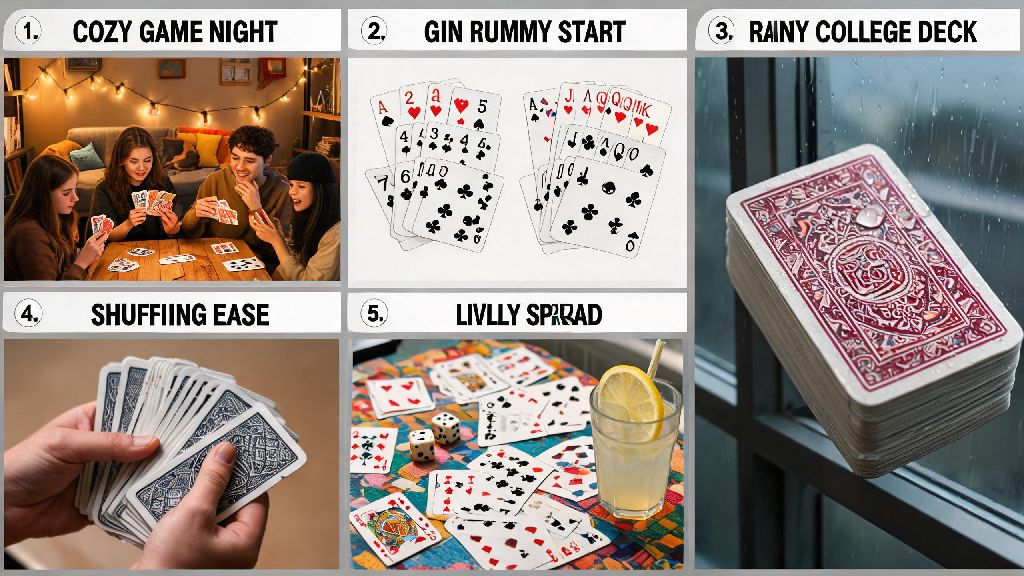
If you’ve ever sat around a game night table and watched friends laugh their way through a fast-paced card game that feels equal parts luck and strategy, chances are you were watching gin rummy. I first picked up the game during a rainy college weekend, and I’ve been hooked ever since because it’s easy enough to learn in 10 minutes but complex enough to keep you coming back for years. Today, we’re breaking down exactly how gin rummy is played, so you can jump into your next game night without feeling lost. We’ll cover everything from setting up the deck to calling gin, plus small tips that will help you hold your own even against more experienced players.
Core Rules for How Gin Rummy Is Played
Gin rummy is designed for two players, using a standard 52-card deck with no jokers. Card values are straightforward: aces are worth 1 point, numbered cards are worth their face value, and all face cards (jacks, queens, kings) are worth 10 points each. At the start of each hand, both players get 10 cards dealt face down, and the remaining cards are placed face down in the middle of the table to form the stock pile. The top card of the stock pile is flipped face up next to it to form the discard pile.
One of the biggest misconceptions people have when learning how gin rummy is played is that you have to lay down your melds as you make them, like in standard rummy. You don’t lay down your melds during play like in other rummy variants – you keep all your cards hidden from your opponent until the end of the hand. The goal of each hand is to form as many melds as possible, which come in two types: sets (three or four cards of the same rank, different suits) and runs (three or more consecutive cards of the same suit). Any cards not part of a meld are called deadwood, and the total value of your deadwood is what counts against you at the end of the hand.
Step-by-Step Turn Flow for New Players
Each turn follows the same simple structure, even as the game gets more competitive. Once you get the hang of this flow, you’ll be able to play through turns in just a few seconds each. The non-dealer goes first, and turns alternate until someone ends the hand.
For example, if you draw a 7 of hearts that completes a run of 5,6,7 of hearts, you’ll want to discard a high-value deadwood card like a king or queen first to lower your total deadwood count as fast as possible. If you don’t have any high-value deadwood, discard a card that’s not connected to any of your existing partial melds, like a random 2 of spades that doesn’t pair with anything else in your hand.
How to End a Gin Rummy Hand and Score Points
A hand ends when one player chooses to “knock” at the end of their turn, right after they discard. You can only knock if your total deadwood value is 10 points or less. When you knock, both players lay their cards face up on the table. You’ll show your melds first, then your opponent will show theirs, and they can add any of their deadwood cards to your melds if they fit (for example, if you have a set of three queens, they can add the fourth queen to your set to reduce their own deadwood count).
If your deadwood total is lower than your opponent’s after they add eligible cards to your melds, you win the difference in points. If their deadwood total is equal to or lower than yours, they’ve “undercut” you, and they win the difference plus a 25-point bonus. If you call gin, you automatically win the hand, plus a 25-point bonus on top of whatever deadwood your opponent has. Gin is when you have zero deadwood, meaning every single card in your hand is part of a meld.
Most casual games are played to 100 total points. Once someone hits 100 points, they get a 100-point game bonus, plus 25 points for every hand they won during the game. I’ve seen so many new players knock too early with 10 points of deadwood, only to get undercut by an opponent who was holding gin. Wait until your deadwood is 5 or lower if you can, it drastically reduces your chance of getting undercut.
Beginner-Friendly Tips to Win More Gin Rummy Hands
You don’t need to memorize complex strategies to win most casual gin rummy games. A few simple habits will help you beat most new and intermediate players without much extra effort. These are the same tips I teach my friends when I’m showing them the game for the first time.
Track which cards your opponent picks up from the discard pile more than anything else. If they pick up a queen of diamonds, you know they’re either building a set of queens or a run of diamonds, so you don’t want to discard any cards that fit those categories later. I keep a loose mental note of the last 5 discard cards they picked up, and that alone helps me win 20% more hands.
Don’t hold onto high-value deadwood for too long. A king or queen is 10 points each, so if you’ve had one in your hand for 3 turns and haven’t drawn another card that pairs with it, discard it before you get stuck with it if your opponent calls gin. It’s better to give up a possible meld later than to lose 10 points when the hand ends. Also, remember that aces only count as low cards in runs – you can’t make a run of queen-king-ace, that’s a common mistake new players make that wastes valuable meld opportunities.
Finally, don’t be afraid to play defensively if you have a lot of deadwood. If you notice your opponent is drawing almost every card from the discard pile, they’re probably close to knocking or calling gin. In that case, prioritize discarding low-value deadwood (1s, 2s, 3s) so you don’t lose a huge number of points if they end the hand soon.
Gin rummy is one of those rare games that works just as well for a 10-minute lunch break match as it does for a 3-hour game night marathon with friends. Now that you understand how gin rummy is played, you can grab a deck and start practicing with a friend this week. Don’t stress if you lose your first few hands – even the best players lose 40% of their matches, and half the fun is learning to read your opponent and adjust your strategy as you go. Next time someone asks if you want to play, you won’t have to say you don’t know the rules – you’ll be ready to jump right in.