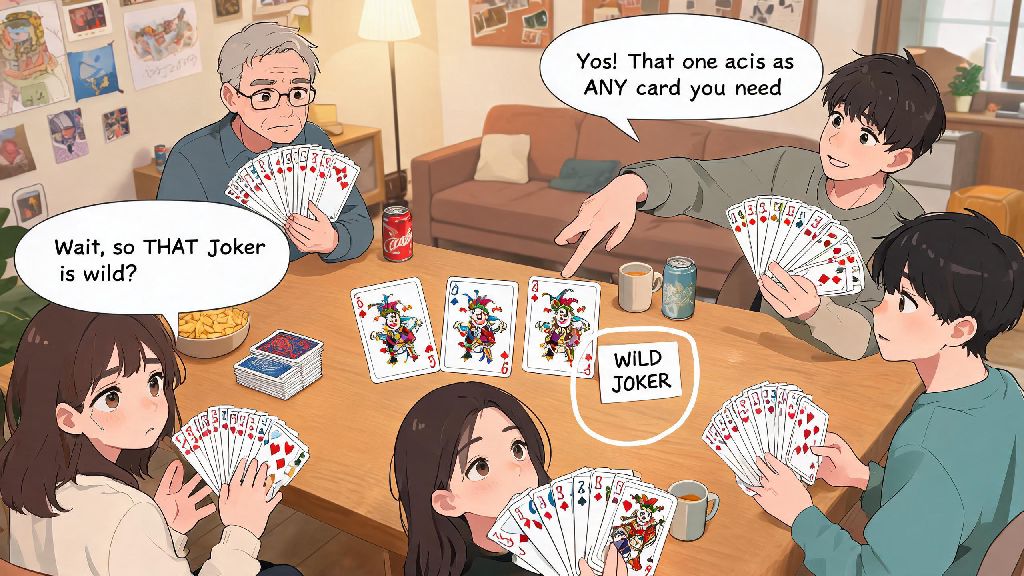
If you’ve ever sat down for a casual rummy game with friends and had someone argue over whether the extra joker cards are allowed, you’re not alone. New players often first ask how many jokers in rummy count as legal, since rules can vary a little depending on who you’re playing with. Most casual games stick to standard rummy guidelines, but there are small tweaks for regional or online variants that you’ll want to know before you place any bets or join a tournament. This guide breaks down standard joker counts, variant exceptions, and simple ways to use jokers to your advantage without breaking any rules.
How Many Jokers in Rummy Follow Standard Global Rules?
For most official 13-card rummy games played with two standard 52-card decks, you’ll have 4 printed jokers (the ones with the jester illustration) plus 1 random wild joker selected at the start of each round, for a total of 5 jokers. If you’re asking how many jokers in rummy are standard for most competitive games, the short answer is 5 for 13-card variants. 4 printed jokers plus 1 random wild joker is the default for all Indian rummy and most international competitive rummy tournaments. But if you’re playing a casual 2-player game with only one deck, you’ll only have 2 printed jokers plus 1 wild joker, for 3 total jokers. That’s a common adjustment for small, low-stakes games with friends.
The random wild joker is picked by flipping a card from the remaining deck after all players have been dealt their 13 cards. Any card matching the value and suit of that flipped card counts as an extra wild joker for the entire round, on top of the printed jokers. For example, if the flipped card is the 7 of spades, all 7 of spades in the deck act as jokers for that round.
Joker Count Differences Across Popular Rummy Variants
Joker counts shift a lot depending on the rummy variant you’re playing, so you never want to assume the standard 5-joker rule applies across the board. Always confirm joker count before starting a paid rummy game, because using too many jokers in your melds can lead to an automatic loss or penalty. If you’re switching between variants, you’ll want to double check how many jokers in rummy are allowed for that specific game to avoid mistakes. Below is a quick breakdown of joker counts for the most popular rummy variants played today:
Gin rummy is the most common variant that skips jokers entirely, so if you’re used to 13-card rummy, you’ll need to adjust your strategy to rely only on natural cards when you play. Online rummy tournaments often add an extra wild joker to speed up game play, which makes rounds faster and more dynamic for large groups of players.
Key Rules for Using Jokers in Official Rummy Games
Even if you know how many jokers are allowed in your game, you can still run into trouble if you don’t follow official joker usage rules. The most important rule new players miss is that a pure sequence without any jokers is mandatory to win a rummy round. No matter how many jokers you have, you can’t declare a win if you don’t have at least one sequence of 3+ consecutive cards from the same suit with no joker substitutions. You also can’t use jokers to make a full set or sequence out of nothing: a 3-card set can have at most one joker, and an impure sequence can only use one joker per 3 cards.
I’ve seen new players lose rounds they would have won because they used a joker in their pure sequence by mistake, so double check your melds before you declare. If the randomly selected wild joker happens to be a printed joker, all aces in the deck become wild jokers for that round, which is a fun twist that can speed up game play significantly. You also can’t use a joker to represent two different cards in the same round, so once you assign it to a specific card value in a meld, you can’t move it to another meld later.
Simple Strategic Tips to Use Jokers to Win More Rounds
Now that you know how many jokers in rummy you can expect to use, you can start building strategies to use them to your advantage instead of wasting them on low-value plays. The biggest tip for new players is never waste a joker on a low-value card like a 2 or 3. If you don’t win the round, you only pay points for the cards left in your hand, so using a joker to replace a 2 saves you 2 points at most, while using it to replace a king saves you 10 points. That means it’s always better to save jokers for high-value cards that would cost you a lot if you get stuck with them.
If you have two jokers, use one for a set and one for an impure sequence, don’t hoard both until the end of the round. Hoarding jokers usually means you’ll run out of time to build your melds, and you’ll end up paying more points when someone else declares. Last month I played in a local rummy tournament and used a joker to replace a missing queen of hearts in my final sequence, cutting 3 turns off my game time and taking first place in the round. If you’re playing online, you can also keep track of how many jokers have already been played to guess if the one you need is still in the draw pile or in an opponent’s hand. You can also intentionally discard low-value cards that match the wild joker to trick opponents into thinking you don’t need that value for your melds.
At the end of the day, how many jokers in rummy are used comes down to the variant you’re playing and the house rules for your game or tournament. For most casual 13-card games, you can expect 5 total jokers, but it always pays to confirm before you deal the first hand. Whether you’re a new player still learning the rules or a seasoned player looking to tweak your strategy, understanding joker counts and uses is one of the easiest ways to improve your win rate and have more fun at the table. Next time you sit down for a game, you’ll know exactly what to expect when those jokers hit your hand.