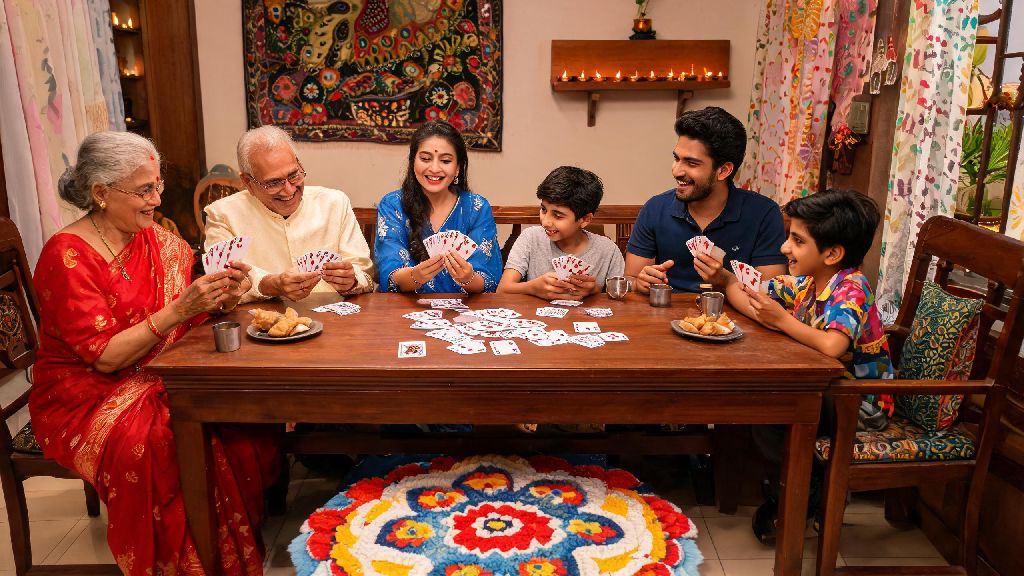
If you’ve ever sat through a family gathering in India and watched relatives huddle over a deck of cards, laughing and teasing each other over discarded cards, you’ve probably seen 13 cards Indian rummy in action. It’s one of the most popular casual and competitive card games across the country, easy enough to pick up in an afternoon but complex enough to keep you coming back for years. If you’re curious how to play 13 cards Indian rummy, this guide breaks down every rule, common confusion point, and quick tip to get you playing your first game confidently. You don’t need any fancy equipment, just a standard 52-card deck (plus one printed joker) and 2 to 6 players to get started.
How to Play 13 Cards Indian Rummy: Core Game Rules
The core goal of every round is to arrange all 13 of your cards into valid groups before any other player. To make a valid declaration, you need at least two sequences, out of which one must be a pure sequence. The remaining cards can be arranged as additional sequences or sets, and you have to discard one final card face down before showing your hand to end the round.
A pure sequence is a group of 3 or more consecutive cards of the same suit, with no jokers used to replace any card. For example, 5,6,7 of hearts counts as a pure sequence, but 5,joker,7 of hearts does not. This group is non-negotiable for a valid declaration, and you will face heavy penalties if you try to declare without one. An impure sequence follows the same consecutive, same-suit rule, but can use one or two jokers to fill gaps. A set is a group of 3 or more cards of the same rank, from different suits, and can also include jokers.
At the start of the round, the dealer shuffles the deck and deals 13 cards to each player. The remaining cards are placed face down in the center as the draw pile, and the top card is flipped over to start the discard pile. A wild joker is also picked at random from the draw pile before the first turn starts. On your turn, you’ll pick one card either from the top of the draw pile (unknown) or the top of the discard pile (visible), then discard one card you don’t need to the discard pile. Play moves clockwise until someone declares a valid hand.
Key Terms You Need to Know Before Your First Game
Rummy has a few specific terms that can feel confusing if you’re hearing them for the first time. Getting familiar with these will help you follow the game and avoid miscommunications with other players:
A lot of new players mix up wild jokers and printed jokers, but they function exactly the same for the purpose of forming groups. The only difference is the wild joker changes every round, while the printed joker stays the same across all games. You can use a maximum of two jokers per group, but remember no jokers are allowed in your pure sequence, no matter what type they are.
Simple Strategies to Win More 13 Card Rummy Games
If you want to move past casual games and start winning more often, these small, easy-to-implement strategies will make a big difference. First, prioritize making your pure sequence before anything else. I’ve seen so many new players get excited about forming three sets right away, only to realize they have no pure sequence and can’t declare, losing the round instantly. If you don’t have two consecutive cards of the same suit within your first three turns, it’s probably a good idea to consider dropping early.
Second, don’t hold onto high-value cards (Ace, King, Queen, Jack) for too long if you can’t form a group with them. Each of these cards is worth 10 points if you lose the round, while number cards are only worth their face value (a 3 of hearts is 3 points, for example). If you’ve held a King of spades for five turns and haven’t picked up a Queen or Ace of spades to go with it, discard it before your opponent declares and you get stuck with the points.
Third, pay attention to what other players are discarding and picking up. If you see a player repeatedly pick up diamond cards from the discard pile, you can assume they’re working on a diamond sequence, so avoid discarding any diamond cards you don’t need if you can help it. You can also use this to your advantage by discarding cards they’re unlikely to need, forcing them to draw from the unknown pile instead. So don’t give away your own strategy by picking up discard pile cards you can’t use immediately.
Common Mistakes New Players Should Avoid
Even if you know all the rules, small mistakes can cost you rounds, especially when you’re first starting out. The most common mistake new players make is submitting an invalid declaration. If you declare your hand without a valid pure sequence, or any of your groups are not properly formed, you’ll get an 80-point penalty, the highest possible in the game. Always double-check your hand before you declare to avoid this.
Another mistake is wasting jokers on groups that don’t need them. For example, if you already have a valid pure sequence of 4,5,6 of clubs, don’t add a joker to it to make it 4,5,6,joker – that’s a waste of a joker you could use to fill a gap in another group. You also shouldn’t pick up cards from the discard pile unless you can use them immediately to form a valid group. Picking up a random card you think you might use later gives your opponents way too much information about what groups you’re building, and you could end up stuck with a card you never use.
Finally, don’t be afraid to drop out of a round if you have a bad hand. A first-drop penalty is only 20 points, a mid-drop is 40 points, and losing to an opponent’s valid declaration can be up to 80 points depending on your hand. It’s better to take the small penalty and wait for the next round than to sink points into a hand you’re very unlikely to win.
13 cards Indian rummy is the kind of game that grows with you the more you play. You’ll start to pick up little tricks, learn to read your opponents’ moves, and get faster at arranging your cards the more rounds you join. Whether you’re playing for fun with family during holiday gatherings or competing in a small local online tournament, learning how to play 13 cards Indian rummy opens up a fun, low-stakes activity you can enjoy almost anywhere. Start with casual games first to get comfortable with the rules, and don’t stress if you lose your first few rounds – even experienced players have bad hands sometimes. Grab a deck, round up a few friends, and give it a try this week.