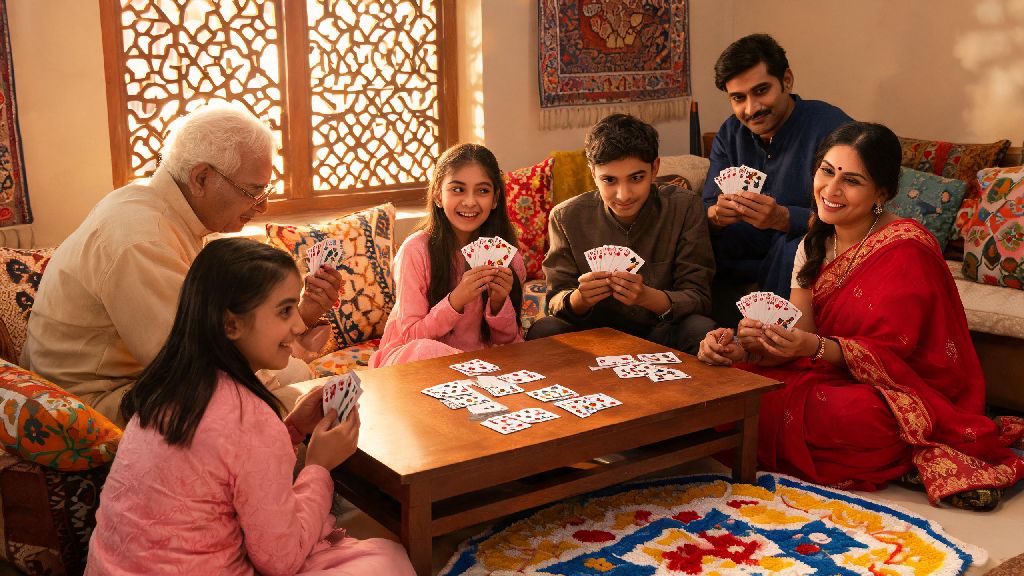
If you’ve ever sat around a family gathering in India and watched relatives laugh while laying down sets of cards, you’ve probably seen a game of Indian rummy in action. Unlike many card games that rely almost entirely on luck, this variant rewards quick thinking, pattern recognition, and a little bit of strategic risk-taking. Learning how to play Indian rummy is far simpler than most new players assume, even if you’ve never touched a rummy-style game before. I’ve been playing casual games with my family for over a decade, and I’ve broken down everything you need to know to join your first game without feeling lost.
Core Setup and Basic Indian Rummy Rules for New Players
Indian rummy uses two standard 52-card decks plus two printed jokers per deck, for a total of 108 cards per game. It works for 2 to 6 players, though most casual games work best with 3 or 4 people. Every player is dealt 13 cards at the start of the round, and the core goal is to arrange all 13 cards into valid combinations before anyone else at the table.
There are two types of sequences you need to know: pure and impure. A sequence is a group of three or more consecutive cards from the same suit. A pure sequence uses no jokers, while an impure sequence can use wild or printed jokers to fill in gaps between cards. You can also form sets, which are three or more cards of the same rank from different suits, with optional joker use.
The most important rule to remember is you need at least one pure sequence to declare a win. Even if all your other cards are arranged into perfect impure sequences and sets, your declaration will be invalid if you don’t have a pure sequence, and you’ll face the maximum possible penalty for that round. After dealing, one random card is picked from the remaining deck to be the wild joker: every card of that rank across all suits acts as a wild joker for the round, on top of the printed jokers.
Step-by-Step Breakdown of How to Play Indian Rummy
Once all cards are dealt, the remaining deck is placed face down in the middle of the table as the closed pile. The top card of the closed pile is placed face up next to it to form the open discard pile, and the wild joker is revealed to all players. Turns move clockwise around the table, starting with the player to the left of the dealer.
On every turn, you have two choices for picking a new card: you can take the top face-down card from the closed pile, or take the top face-up card from the open discard pile. After picking your new card, you have to discard one card you don’t need to the open pile to keep your total at 13 cards. If you pick a card from the open pile, you can’t discard that same card on the same turn – you have to keep it for at least one round.
To make it easier to understand valid combinations, here’s a quick breakdown of what counts and what doesn’t:
Once you’ve arranged all 13 of your cards into valid combinations, you can declare on your turn. You’ll lay your cards face up for all players to check, and if your arrangement is valid, you win the round. All other players are assigned penalty points based on the value of their unarranged cards, with face cards and aces worth 10 points each, numbered cards worth their face value, and jokers worth 0 points.
Simple Winning Strategies Even Beginners Can Use
You don’t need to memorize complex plays to win your first few games of Indian rummy, and small, consistent choices will make a huge difference in how often you come out on top. The first and most important rule is to stop treating every card like it’s useful. If you have a high-value card like a King or Queen that doesn’t fit into any potential sequence or set after your first two turns, discard it. High-value cards cost you far more in penalties if you lose, so holding onto them “just in case” is almost never worth the risk.
Prioritize building your pure sequence first, before you work on any other combinations. I can’t count how many times I’ve seen new players build three perfect sets and an impure sequence, only to realize they have no pure sequence and can’t declare. As soon as you get your initial 13 cards, scan for two or three consecutive cards of the same suit, and prioritize picking cards that help you complete that pure sequence before you work on anything else.
Pay attention to what other players are discarding, too. If a player keeps discarding low spades turn after turn, they’re almost definitely not building a spade sequence, so you can safely pick up spade cards from the open pile without worrying you’re taking something they need. Track the wild joker and all printed jokers you see discarded, so you know how many are left in play that you could pick up. If all four wild jokers have already been discarded, you don’t want to hold onto a partial impure sequence that’s waiting for a joker that doesn’t exist.
Common Mistakes New Players Make (and How to Avoid Them)
The most common mistake new players make is declaring too early without double-checking their hand. A wrong declaration usually comes with an 80-point penalty, which is enough to knock you out of most casual tournaments immediately. Before you declare, take 10 seconds to confirm you have a valid pure sequence, that none of your sets have duplicate suits, and that all 13 of your cards are accounted for. It only takes a few extra seconds, and it will save you from a lot of frustrating losses.
Another common mistake is picking too many cards from the open pile. Every time you pick a card from the open pile, every other player at the table sees what card you took, so they can easily guess what combination you’re building. Only pick from the open pile if that card immediately completes a sequence or set for you. Otherwise, stick to the closed pile, where no one can see what card you’re adding to your hand.
Don’t fall into the trap of playing too defensively, either. Many new players refuse to discard any card that could possibly be useful later, so they end up with a hand full of random high-value cards that don’t form any combinations. Rummy is a game of small trade-offs, and sometimes you have to discard a card that might be useful later to avoid getting stuck with a pile of high-point cards if someone else declares first. If you’re unsure about a card, ask yourself if you’re likely to pick up the other cards you need to make a combination with it in the next three turns. If the answer is no, discard it.
Indian rummy is one of those games that takes 15 minutes to learn, but a lifetime to master, and that’s part of what makes it so fun to play with friends and family, or even online against other players. You don’t need to be a pro to enjoy your first game, as long as you remember the core rules and avoid the common mistakes we covered. Next time you get invited to a game, you won’t have to sit on the sidelines – you’ll know exactly how to play Indian rummy and hold your own against more experienced players. Take it slow on your first few rounds, focus on building that pure sequence first, and don’t get discouraged if you lose a few times at first – even the best players started exactly where you are now.