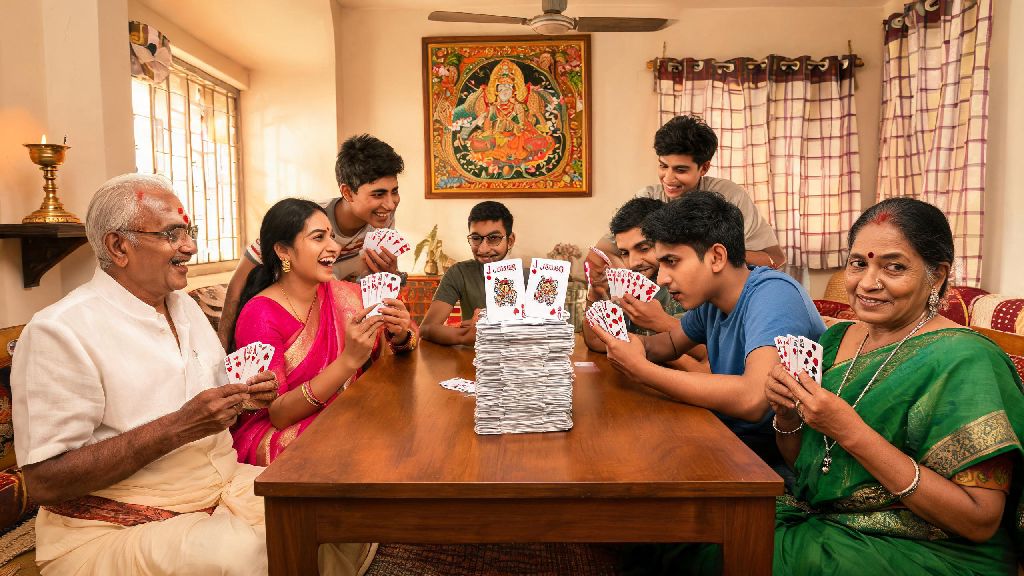
If you’ve scrolled through Tamil social media feeds or joined family gatherings in 2026, you’ve probably seen groups huddled over phones or tables laughing and playing the beloved card game rummy. Whether you want to join weekend game nights with your cousins or try your hand at low-stakes online matches for fun, learning how to play rummy Tamil style is far simpler than most new players assume. Unlike generic international rummy variants, the Tamil version has small, local tweaks that make it feel far more familiar and fun for players from the community, and we’re breaking all of it down in this guide.
Core Rules You Need to Know to Play Rummy Tamil Style in 2026
The Tamil version of rummy is a 13-card draw-and-discard game, usually played with 2 to 6 players, using 2 standard 52-card decks plus 2 printed jokers. The core objective is to arrange all 13 of your cards into valid sequences and sets before any other player, or to have the lowest number of points if someone else declares first. It’s classified as a skill-based game across Tamil Nadu in 2026, so you don’t have to worry about legal hurdles when playing on licensed platforms or at casual private gatherings.
One of the biggest differences between Tamil rummy and other variants is the strict requirement for sequences over sets, a rule that has stood for decades even as other parts of the game have evolved for online play. 13 cards per player is the universal standard for all casual and competitive Tamil rummy games in 2026, so you won’t run into variants that use more or fewer cards unless you’re playing a custom house rule with friends. Points are calculated based on the value of unarranged cards when a player declares, with face cards (Ace, King, Queen, Jack) worth 10 points each, numbered cards worth their face value, and jokers worth 0 points.
I’ve seen so many new players lose their first round just because they forgot that a pure sequence (no jokers) is non-negotiable, even if all their other sets are perfect. That rule is non-negotiable across almost all Tamil rummy house rules, so it’s the first thing you should prioritize when you get your initial set of cards.
Step-by-Step Process to Play Your First Rummy Tamil Game
Every game follows the same basic flow, whether you’re playing offline with physical cards or online on a popular gaming app. First, the dealer shuffles the deck and deals 13 cards to each player, then places the remaining deck face down in the center as the draw pile. The top card of the draw pile is placed face up next to it as the discard pile, and one random card from the deck is selected as the wild joker for the entire game, alongside the 2 printed jokers.
On your turn, you’ll pick one card either from the top of the face-down draw pile or the top of the face-up discard pile, then discard one card you don’t need to the discard pile. Your goal across turns is to arrange all your cards into valid groups, and you can declare a win once all your cards meet the required criteria. Before you declare, you need to make sure your hand meets all 4 of these mandatory requirements:
You cannot discard a joker in 90% of Tamil rummy house rules, so if you pick a joker by mistake, you have to keep it in your hand for the rest of the round. If you declare and your hand doesn’t meet all the above requirements, you’ll get an 80-point penalty, which is the maximum possible penalty for a single round, so always double check your groups before you hit the declare button or lay down your cards offline.
Common Mistakes New Tamil Rummy Players Make (And How to Avoid Them)
Even if you memorize all the rules, you’re likely to make a few missteps in your first 10 to 15 games, and that’s totally normal. But there are a handful of super common mistakes that you can avoid easily if you know what to look for, which will save you a lot of lost points and frustration as you learn.
The biggest mistake I see new players make is prioritizing sets over sequences, or putting off making their pure sequence until later in the game. If you don’t have a pure sequence by the time another player declares, you automatically get 80 points, no matter how well arranged the rest of your cards are. So always focus on making your pure sequence first, before you start working on any other groups. High value cards (Ace, King, Queen, Jack) cost 10 points each if you lose, so if you haven’t formed your sequences by the 10th turn, it’s better to discard them early to cut your losses if someone else declares first.
Last month, I played a casual game with my friends in Coimbatore, and one new player held onto three Kings for half the game hoping to form a set, only to lose 80 points when someone else declared first. Don’t make that same mistake. If you have a high value card that you haven’t been able to pair with others after 5 or 6 turns, get rid of it. Another common mistake is discarding cards that are close in rank to the cards your opponents have picked up from the discard pile. If you see an opponent pick a 7 of hearts from the discard pile, don’t discard a 6 or 8 of hearts later on, because there’s a high chance they need it for a sequence.
You also don’t have to play every hand to win. If your initial 13 cards are really bad—no consecutive cards, no matching ranks, no jokers—it’s totally okay to fold early and only take 20 points instead of risking 80 points later on. Many new players feel like they have to stick out every hand, but folding is a perfectly valid strategy for new players who are still learning the rhythm of the game.
2026 Updates to Online Rummy Tamil Play Rules You Should Know
If you plan to play rummy on online platforms instead of offline with friends, there are a few 2026 regulatory updates you should be aware of before you sign up for any app. The Tamil Nadu government updated its skill gaming regulations in late 2025 to make licensed online rummy platforms fully legal, as long as they follow strict consumer protection rules, so you don’t have to worry about scams or unfair play if you use a licensed platform.
All licensed online rummy platforms operating in Tamil Nadu in 2026 are required to show the point calculation in real time, so you can see exactly how many points you’re at risk of losing at any point during the round, which is a huge help for new players who are still learning how to count points. They’re also required to offer free practice games with no real money involved, so you can play hundreds of rounds to get comfortable with the rules before you put any money on the line.
Another new rule for 2026 is that all platforms have to implement mandatory responsible play features, including daily deposit limits, optional self-exclusion periods, and pop-up reminders if you’ve been playing for more than 2 hours straight. That’s a big shift from a few years ago, when many platforms had no protections for players who might be at risk of overspending. If you’re looking for a platform to play on, make sure it displays its Tamil Nadu gaming license clearly on its homepage, and avoid any unlicensed apps that ask for upfront deposits without offering free practice games first.
At the end of the day, rummy is meant to be a fun, social game you can enjoy with friends and family, whether you’re playing offline at a wedding function or online during your commute. Now that you know the basics of how to play rummy Tamil style, you can join your next game night with confidence, no matter if you’re playing for small cash prizes or just bragging rights. Start with low-stakes or free practice games first to get comfortable with the rules, and don’t stress if you lose your first few rounds—even the best rummy players started exactly where you are now.