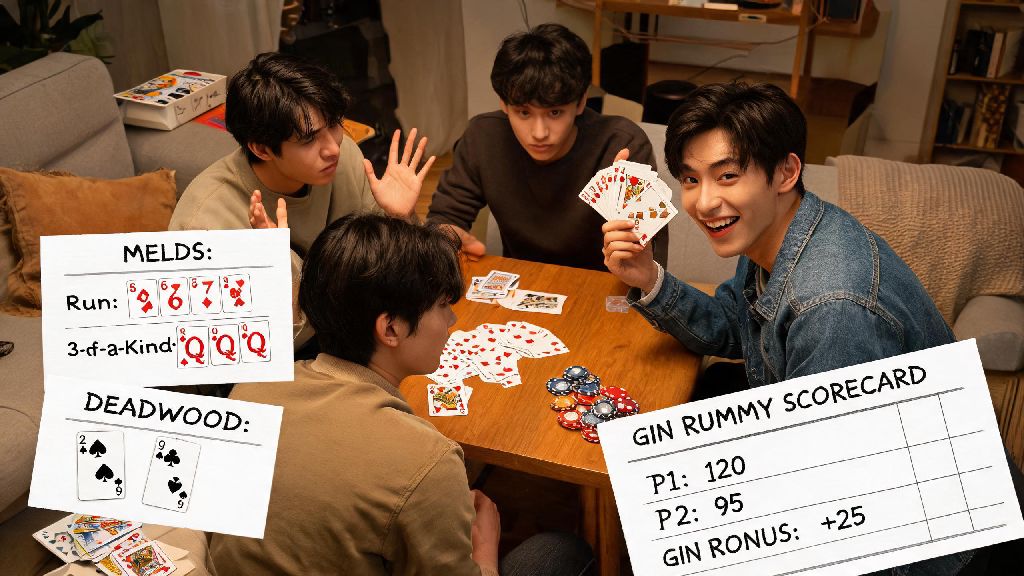
If you’ve ever wrapped up a tight gin rummy match with friends only to get into a 20-minute argument over who actually won, you’re not alone. I’ve lost more silly low-stakes bets than I can count because someone counted their deadwood wrong, or forgot the bonus for an undercut. Even if you’re a pro at forming melds and reading your opponent’s discards, you’ll never win consistently if you don’t know how to score gin rummy properly. I spent a weekend digging through official American Gin Rummy Association rules after losing a $10 bet to my college roommate, and I’ve compiled everything you need to know to avoid the same mistakes I made. This guide works for casual home games, local league matches, and even online competitive play, so you can count on it no matter where you play.
Core Rules to Follow When You Score Gin Rummy
Before you start tallying points at the end of a round, you need to get the foundational rules right, because a single wrong assumption can throw off your entire score. First, you have to separate your cards into melds and deadwood. Melds are either three or four of a kind (like three queens or four 7s) or runs of three or more consecutive cards of the same suit (like 5,6,7 of hearts). Any cards that don’t fit into a valid meld count as deadwood, and those are the only points that count against you at the end of a round.
Face cards (jack, queen, king) are worth 10 points each, no exceptions. Aces are always worth 1 point, not 11 – this is the most common mistake new players make, and it can add 10 extra points per ace to your deadwood count if you get it wrong. Numbered cards 2 through 10 are worth their face value, so a 5 of diamonds is worth 5 points, a 9 of clubs is worth 9 points, and so on.
The goal of every round is to get your deadwood count as low as possible. If you get your deadwood down to 0, you have a gin, which comes with a big bonus and ends the round immediately. If your deadwood is 10 points or lower, you can knock to end the round early, before you get a gin, if you think your deadwood is lower than your opponent’s.
Step-by-Step Scoring Process for a Standard Gin Rummy Round
Once someone knocks or gets a gin, the round ends and you can start scoring. This process is the same for most standard games, unless you’re playing a specific variant with adjusted rules. First, both players lay all their cards face up on the table, and clearly separate their melds from their deadwood. If the round ended with a knock, the non-knocking player gets the chance to lay off any of their deadwood cards that fit into the knocker’s melds, to lower their own deadwood count. For example, if the knocker has a meld of three 8s, the non-knocking player can add their fourth 8 to that meld to remove it from their deadwood.
Once layoffs are done, calculate the total deadwood points for both players. If the round ended with a gin, there are no layoffs allowed, and the gin player automatically gets a 25-point bonus, plus the total value of their opponent’s deadwood. No points are subtracted for the gin player’s deadwood, since their count is zero.
If the round ended with a knock, you’ll compare the two deadwood counts. If the knocker has a lower deadwood count than their opponent, they win the round. They get a 20-point bonus, plus the difference between their deadwood count and their opponent’s. If the non-knocking player has a lower or equal deadwood count, that’s an undercut. Undercuts happen when the non-knocking player has lower deadwood than the knocker, and in that case, the non-knocking player wins the round, gets a 25-point bonus, plus the difference between the two deadwood counts.
For example, if you knock with 6 points of deadwood, and your opponent has 12 points left after layoffs, you get 20 + 6 = 26 points for the round. If you knock with 6 points, and your opponent only has 4 after layoffs, they get 25 + 2 = 27 points for the round, even though you were the one who knocked. That’s why it’s important to be careful about knocking too early, especially if you think your opponent is close to a gin or has very low deadwood.
Common Scoring Mistakes Even Regular Players Make
I’ve played gin rummy with hundreds of people over the years, from casual players at family gatherings to competitive players in local tournaments, and I see the same mistakes pop up over and over again. Most of these mistakes are honest, but they can cost you games, bets, and even tournament placements if you don’t catch them early. The most common ones are:
No layoffs are permitted after a gin, no matter what house rules you’ve heard of in the past. This is an official rule across almost all standard gin rummy leagues and tournaments, so it’s a good habit to follow even in casual games. If you’re playing with a group that allows layoffs after gin, make sure everyone agrees to that rule before you start the game, so there’s no confusion later.
Another common mistake is forgetting to track running scores correctly. If you’re playing to 250 points (the standard winning total for most games), it’s easy to add a round’s points to the wrong player’s total if you’re not writing them down as you go. I always keep a small notepad next to my game table, even for casual games, because it eliminates all arguments about who is ahead halfway through the match.
Scoring Differences for Popular Gin Rummy Variants
The scoring rules we’ve covered so far apply to standard gin rummy, but there are dozens of popular variants that have adjusted scoring rules. If you’re switching to a new variant, it’s critical to learn the scoring differences before you start playing, because they can completely change your strategy for the game.
Oklahoma Gin is one of the most common variants, and its scoring difference is tied to the first upcard at the start of the round. The value of that upcard is the maximum deadwood count you can have to knock. So if the first upcard is a 7, you can only knock if your deadwood is 7 points or lower, not 10. If the first upcard is a spade, all bonuses for that round are doubled, so a gin bonus becomes 50 points, an undercut bonus becomes 50 points, and so on.
Hollywood Gin is a multi-game variant where you track three separate running scores at the same time. Your first gin of the match counts towards your first game score. Your second gin counts towards both your first and second game scores. Your third and all subsequent gins count towards all three game scores. You win each game when you hit 250 points in that score column, and the overall winner is the player who wins two out of the three games. This variant is popular for long game nights with friends, because it adds an extra layer of strategy to your scoring decisions.
Straight Gin is the most high-stakes common variant, because you can’t knock at all. The only way to end a round is to get a gin, so deadwood counts don’t matter until someone has zero. The gin bonus for Straight Gin is usually 30 points instead of 25, to account for the extra difficulty of getting a gin without the option to knock early.
Always confirm scoring rules with your group before starting a game, especially if you’re playing with people you don’t usually play with. House rules are extremely common for gin rummy, and what’s standard for your family might be unheard of for another group. Taking 30 seconds to go over the scoring rules before you deal the first hand will save you hours of arguments later.
Scoring gin rummy doesn’t have to be complicated, and once you run through the process a few times, it’ll become second nature. You don’t have to memorize every single variant rule off the bat, but getting the standard rules down will help you avoid most common mistakes and enjoy your games more, without the post-round arguments. Whether you’re playing for fun with friends or competing in a local tournament, taking the time to learn how to score gin rummy correctly will make you a better, more consistent player, and you’ll never lose a bet over a silly counting mistake again. Next time you sit down for a game, keep a notepad handy, count your deadwood out loud if you need to, and don’t be afraid to double check a rule if you’re unsure – everyone makes mistakes, even experienced players.