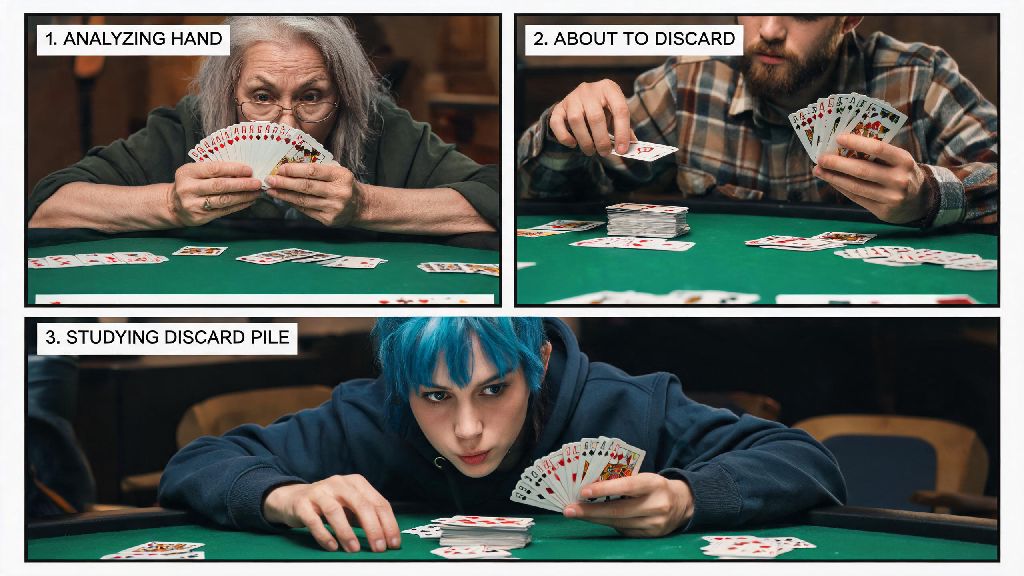
If you’ve ever sat through a gin rummy game where your opponent seems to always meld first, knock before you can build a single set, and leave you holding a pile of high-point cards, you know how frustrating losing repeatedly can be. Most new players assume luck is the biggest factor in the game, but that’s far from the truth. Learning how to win gin rummy is less about getting lucky draws and more about making small, intentional choices every turn that stack the odds in your favor. I’ve played casual and competitive gin rummy for over 12 years, and I’ve tested every hack and trick out there to separate the strategies that actually work from the ones that sound good on paper. In this post, I’ll break down the exact tactics you can use to start winning more games, no matter your skill level.
Master Discard Strategy to Control the Flow of Every Game
Most new players only think about their own hand when they discard, but every card you throw away gives your opponent critical information about what you’re holding. The biggest mistake I see new players make is throwing away low-value cards first to reduce their deadwood count early. That might seem smart, but it actually tells your opponent you’re not building any sets or runs that use those low cards, and it gives them safe cards to pick up for their own melds. Your first priority when discarding is to avoid giving your opponent usable cards, even if that means holding on to a few extra points of deadwood for a turn or two. For example, if your opponent has already picked up a 5 of spades from the discard pile, throwing a 5 of hearts or 4 of spades is an unnecessary risk, even if those cards aren’t useful to you. Wait a turn or two to see what they discard next before you get rid of adjacent or matching rank cards.
You also want to mix up your discard pattern so your opponent can’t predict what you’re holding. If you always discard the highest point card in your hand that you don’t need, your opponent will quickly catch on and start avoiding throwing cards you might want. This is one of the simplest changes you can make to how you play, and it’s the fastest way to improve your win rate with very little extra effort. You don’t have to overcomplicate it, just throw a low-point card you don’t need every 3 or 4 turns instead of your usual highest point discard, and you’ll throw off their reads completely.
Build Flexible Melds to Adapt to Unpredictable Draws
A lot of new players lock into their meld plans as soon as they get their initial 10 cards, and they refuse to adjust even when draws don’t go their way. That’s a surefire way to end up stuck with 20+ points of deadwood when your opponent knocks early. Flexible melds are hands that can turn into multiple different sets or runs depending on what cards you draw, and they’re the secret to building winning hands fast, even with bad luck. Let’s say you have a 7 of diamonds, 8 of diamonds, and 8 of hearts. A lot of players will hold out for either a 6 or 9 of diamonds to make a run, or a third 8 to make a set. But if you pick up a 9 of hearts, you can shift to building a run of 7,8,9 of hearts instead, or keep both options open by holding all four cards until you draw the missing piece.
You don’t have to meld as soon as you have three matching cards, either. Holding off on melding can keep your opponent guessing about what cards you need, and it lets you adjust your hand if you draw a better combination later. The only time you should meld early is if you have less than 10 points of deadwood left and you’re ready to knock to end the game before your opponent can build their own hand. This flexibility is what separates casual players from those who know how to win gin rummy on a regular basis, even when they don’t get great initial hands.
Use Endgame Tactics to Lock in Wins When Learning How to Win Gin Rummy
Once you or your opponent gets down to 10 or fewer points of deadwood, the game shifts from building melds to minimizing your losses and maximizing your points. A lot of players throw away wins at this stage because they get greedy trying to get a gin, instead of locking in a guaranteed win by knocking. I’ve seen dozens of players lose a 20-point lead because they held out for one extra card for gin, only for their opponent to knock first and leave them holding all their high-point deadwood. When you’re in the endgame, follow these simple rules to avoid costly mistakes:
That last rule is non-negotiable for me, personally. If I only have one out for gin, I’ll almost always knock instead of waiting, because the odds of drawing that one card are just too low to justify the risk of my opponent beating me to the punch. If you’re playing for points across multiple games, small consistent wins add up far faster than rare gin payouts anyway. So don’t let the allure of a big gin win make you throw away a guaranteed smaller win. It’s not worth the risk 9 times out of 10.
Track Opponent Behavior to Spot Patterns You Can Exploit
Gin rummy isn’t just a game of cards, it’s a game of people. If you’re playing against the same opponent more than once, or even if you’re just in a single long game, you can pick up small patterns in their play that give you a huge edge. Most casual players don’t even realize they have these patterns, so exploiting them feels like cheating, but it’s totally fair game. You don’t have to be a professional player to spot these patterns, even casual players have predictable habits after just a few rounds. For example, I once played against a regular opponent who always discarded the highest point card in their hand that they didn’t need, no matter what. So if they threw a queen of clubs, I knew they didn’t have another queen, and they didn’t have a jack or king of clubs either. That let me discard those cards safely for the rest of the game, and I won 7 out of 10 games we played that day.
Pay extra attention to what cards your opponent picks up from the discard pile, and what they throw away immediately after. That tells you exactly what melds they’re building, so you can avoid throwing them the cards they need, and even hold on to those cards to force them to draw from the stock pile instead. You don’t have to memorize every card that’s been played, either. Just tracking the last 5 or 6 discarded cards is enough to give you a clear picture of what your opponent is working on, and what cards are safe to throw away. Even this small amount of tracking will give you a huge edge over players who don’t pay attention to anything but their own hand.
Gin rummy is a game that balances luck and skill perfectly, so don’t get discouraged if you lose a few games even when you’re using all these tactics. Over time, the small choices you make every turn will add up to far more wins than losses, and you’ll start noticing that you’re beating players who used to crush you regularly. The best way to get better is to practice these tactics one at a time, starting with discard strategy, until they feel like second nature. If you stick to these tips, you’ll be shocked at how quickly you start seeing results. Learning how to win gin rummy doesn’t require any special talent or photographic memory, it just requires paying attention to the small details and making intentional choices every turn. Next time you sit down for a game, try out just one of these tactics, and see how much of a difference it makes in your final score.