If you’ve ever sat down for a casual game of rummy with friends and froze when someone called out a “straight,” you’re not alone. Most new players take a few rounds to wrap their heads around core card combinations, and understanding what is a straight in rummy is one of the first milestones to playing the game confidently. Straights (also called runs) are the backbone of almost every valid rummy hand, and getting them right can mean the difference between winning big and getting stuck holding high-point cards at the end of a round. I’ve been playing rummy for 12 years, both at local game nights and online tournaments, and I still see even intermediate players mess up straight rules now and then, so we’re breaking everything down clearly in this post.
What is a Straight in Rummy, Exactly?
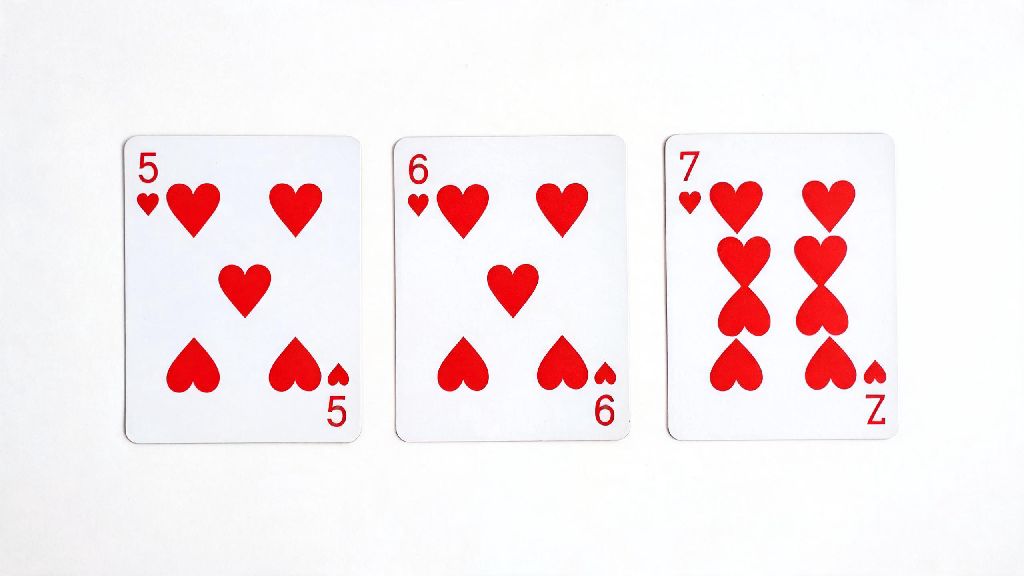
At its core, a straight is a combination of three or more consecutive ranked cards, all from the same suit. For example, 5 of hearts, 6 of hearts, 7 of hearts is a basic valid straight that works in every standard rummy variant. When people ask what is a straight in rummy, they often forget to ask about the difference between pure and impure straights, which is a critical distinction for most competitive play. A pure straight has no wild cards, jokers, or printed wild cards (like 2s in some variants) filling in gaps. An impure straight uses one wild card to replace a missing card: for example, 5 of diamonds, joker, 7 of diamonds counts as an impure straight.
Core rule for all standard rummy variants: A straight requires a minimum of three cards in sequential rank, all from the same suit, with no duplicate ranks. I’ve played with groups that used house rules letting mixed suits count as straights, but that’s not standard for competitive or online rummy, so don’t carry that habit over to tournament play if you ever level up. Pure straights are always more valuable, and in Indian rummy, you need at least one pure straight to even declare your hand, no matter how many other valid combinations you have. I’ve seen new players lose entire tournament rounds because they had three impure straights and no pure one, so this is a rule you don’t want to forget.
Key Rules for Valid Straights Across Common Rummy Variants
While the base definition of a straight stays consistent, there are a few edge rules that apply across almost all official rummy rule sets, and it pays to memorize them before you play for points. First, ace rules: Aces can be used as a low card (A, 2, 3) or high card (Q, K, A) depending on the straight you’re building. You can’t wrap around to make a straight like K, A, 2 – that’s invalid in every official rule set, no matter what casual house rules you’ve encountered before. Second, wild card limits: Most variants only let you use one wild card per straight, even if you have multiple jokers in your hand. Third, maximum length: You can make a straight as long as 13 cards if you get extremely lucky, but most players aim for 3-4 card straights since they’re far easier to complete.
New players make a handful of very common straight mistakes when they’re first starting out, so keep an eye out for these errors:
Always check the variant rules before you start playing, because some regional rummy versions have slightly different straight requirements, especially for wild card usage. For example, some versions of Gin Rummy let you use up to two wild cards per straight, while others ban wild cards entirely. It only takes 30 seconds to confirm the rules before you deal the first hand, and it will save you a lot of frustration later.
How to Use Straights to Improve Your Rummy Win Rate
Now that you know what counts as a valid straight, you can start building them strategically instead of just grabbing random consecutive cards. First tip: Prioritize building a pure straight first if you’re playing a variant that requires it. There’s nothing worse than having a full hand of valid combinations except no pure straight, and being stuck with all your points when someone else declares. Don’t hold onto partial straights for too long, either. If you have 4 and 5 of diamonds and have gone 3 turns without pulling a 3 or 6 of diamonds, it’s probably time to discard those cards and pivot to another combination.
Holding onto dead cards for a potential straight is one of the biggest mistakes new players make, because it clogs up your hand and keeps you from building other valid sets. I once held onto a 2 and 4 of spades for 6 turns in a local tournament, waiting for a 3, and ended up losing the round by 47 points because I didn’t pivot. I never make that mistake anymore. If you’re playing against other people, watch what they discard. If someone throws away a 7 of clubs, you know they’re not building a straight that uses that card, so you can feel safer holding onto 6 and 8 of clubs if you’re looking for that 7. Straights are harder to block than sets, too, since opponents can only guess the range of cards you need, instead of knowing exactly which rank you’re missing for a three-of-a-kind.
If you’re playing open hand rummy where you can see opponent’s melds, straights are even more valuable because they’re harder to block. For example, if you have a partial straight of 9 and 10 of hearts, an opponent would have to hold both the 8 and Jack of hearts to block you, which is very unlikely. If you’re building a set of queens, they only need to hold one queen to block you, which is far more common. So if you have a choice between building a straight or a set early in the round, go for the straight first to give yourself better odds of completing it.
Common Straight Misconceptions Debunked
I’ve heard so many wrong ideas about straights over years of playing rummy, so let’s clear up the most persistent myths. First myth: “Longer straights are always better.” No, that’s not true. A 3-card pure straight is worth the same as a 5-card pure straight in most variants, and the longer one uses up more cards that you could have used for other combinations. You’re usually better off building two short straights than one long one if you want to declare your hand faster. The only exception is if you’re playing a variant that gives bonus points for extra-long straights, but those are rare outside of custom home game rules.
Second myth: “Wild cards can be used to replace two consecutive cards in a straight.” No, most official rules only let you use one wild card per straight, even if you have multiple jokers. Some casual groups let you use two, but that’s not standard, and you’ll get called out for it in competitive play. Third myth: “Straights are only for new players.” A lot of intermediate players shift to only building sets because they think they’re easier to complete, but pro players use straights all the time because they’re less predictable. If you discard a 9 of hearts, opponents can’t tell if you’re building a straight around 7-8 or 10-J of hearts, whereas if you discard a king, they can guess you’re not building a set of kings.
Another common myth is that straights are harder to build than sets. The odds are almost identical for 3-card combinations: for a 3-card straight with one gap, you have two possible cards that can complete it (the card below or above your current sequence). For a 3-card set with one missing card, you have two possible copies of that rank left in the deck, so the odds are almost exactly the same. The only difference is that you have to pay attention to suit for straights, which takes a little practice, but it becomes second nature after a few rounds.
At the end of the day, getting comfortable with building and using straights will make you a far more versatile rummy player, no matter if you play casual home games or competitive online matches. Now that you know what is a straight in rummy, you can stop second-guessing your combinations and start making strategic choices that help you win more rounds. The best way to get better is to practice: next time you sit down for a game, make a point to prioritize building at least one pure straight first, and see how much faster you can complete your hand. You’ll be surprised at how much of a difference this small shift makes to your overall win rate.