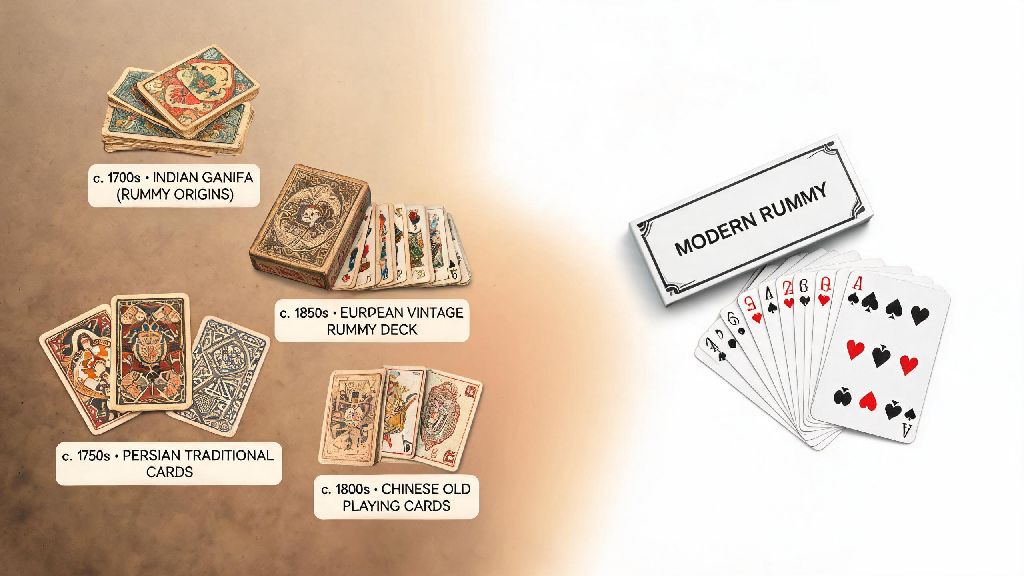
If you’ve spent any time playing casual card games at family holidays, game nights with friends, or even on mobile apps, you’ve almost certainly tried your hand at rummy. It’s one of the most widely played card games in the world, with hundreds of regional variants tailored to different group sizes and play styles. One of the most common questions new and long-time players alike ask is who invented rummy game, and the answer is a lot more interesting than you might expect.
Who Invented the Rummy Game? Leading Historical Theories
If you’re looking for a single name to attach to rummy’s creation, you’re going to be disappointed. There is no single, verified individual credited as the sole inventor of rummy, because the game evolved gradually from a family of matching card games played across multiple continents over hundreds of years. Most historians agree on two leading origin theories that explain how the modern version of rummy came to be.
The first and most well-documented theory ties rummy to Conquian, a 19th century card game played in Mexico. Conquian was brought to the southern United States by Mexican migrant workers in the 1850s, and it quickly spread across the country through saloons and community gatherings. It shares almost all of rummy’s core mechanics, including melding sets of matching cards and runs of sequential cards, and it’s widely considered the direct ancestor of modern rummy.
The second, less verified theory connects rummy to Khanhoo, a Chinese card game dating back to the Tang dynasty. Proponents of this theory argue that Khanhoo’s matching and melding rules were brought to Europe by traders in the 1800s, and eventually adapted into the rummy-style games that spread to the Americas. There’s far less concrete evidence for this line of evolution, but it does explain the similarities between rummy and East Asian matching games like Mahjong.
People searching for who invented rummy game are often surprised to learn that the game has no official creator, but that’s part of what makes its history so rich. It’s a game shaped by hundreds of communities adapting rules to fit their own needs, rather than one person’s deliberate design.
How Early Rummy Variants Shaped the Modern Game
Even if we don’t have a single inventor for the base rummy game, we do have confirmed creators for many of the most popular rummy variants that are played today. As Conquian spread across the US in the late 1800s, players began tweaking its rules to work for different group sizes, play speeds, and skill levels, leading to the wide range of rummy versions we know now.
Gin Rummy is the first widely popular rummy variant with a confirmed named creator. It was designed by Elwood Baker, a card game designer from New York, in 1909. Baker wanted to create a faster, lower-stakes version of rummy that worked well for two players, and it quickly became a mainstream hit, especially during the Great Depression when low-cost home entertainment was in high demand.
Some of the most influential early rummy variants that shaped modern play include:
All rummy variants share the core rule of melding valid sets and runs to discard all your cards first, no matter how much their other rules differ. That shared core is why it’s so easy for players to pick up a new rummy variant even if they’ve only ever played one version before.
Common Myths About Rummy's Origin Debunked
Because rummy’s origin is so spread out and poorly documented for much of its early history, a lot of untrue myths have popped up about where it came from. Many of these myths have been repeated so often online that players assume they’re fact, but there’s no historical evidence to back them up.
One of the most common myths is that rummy was invented by French aristocrats in the 1700s. There are no surviving French rule books or references to a rummy-like game from that time period, and this myth likely started as a marketing tactic for early 20th century rummy sets that wanted to frame the game as a fancy, upper-class pastime. Another popular myth is that rummy was created by US soldiers during World War I to pass time in the trenches, but we have documented references to rummy being played in the US as early as the 1870s, decades before the war started.
Many origin myths spread because early rule books often credited vague, unnamed sources to sell more copies. I’ve even seen claims online that rummy was invented by a New Orleans gambler in the 1880s, but there are no newspaper records, court documents, or surviving rule sets to support that story. It’s fun to imagine a dramatic origin story for the game, but the real history of community adaptation is far more interesting.
Why Rummy's Evolution Matters for Modern Players
You might be wondering why you should care about rummy’s messy, unconfirmed origin story as someone who just plays the game for fun. The truth is, understanding how rummy evolved can make you a better player, and help you avoid frustration when you play with new groups or try new variants.
Since rummy was shaped by hundreds of different communities adapting rules over time, there’s no single “official” set of base rummy rules. That means if you’re playing at a friend’s house and they follow a rule you’ve never heard of, it’s not necessarily wrong – it’s just their local variant. You don't have to follow strict "original" rummy rules to have fun with friends and family, and you can even tweak rules to fit your group’s preferences, like adding extra jokers or changing point values for melds.
That said, if you’re planning to play in paid online rummy tournaments, it’s still important to check the specific rule set for the variant being played before you join. Different platforms use different house rules, and assuming you know the rules based on your home game can lead to costly mistakes. It’s also a good idea to confirm rules with the group before you start a casual game, to avoid arguments halfway through play.
At the end of the day, we’ll probably never be able to name one specific person who invented rummy game, and that’s okay. Its cross-cultural, community-driven evolution is part of what makes it such a universal, beloved game across the world. Next time you sit down for a game of rummy, you can even share these origin facts with your group – it’s a great conversation starter, and it might even stop a few arguments about which rules are “real” rummy.