If you’ve ever sat down for a casual round of gin rummy with friends only to get confused when someone calls “gin” and starts tallying points, you’re not alone. A lot of new players pick up the basic meld rules quickly, but get stuck when it comes to calculating final scores fairly. We’re breaking down exactly how do you score gin rummy for both casual home games and official tournament play, with no confusing jargon or hidden fine print. You won’t have to argue over point values or undercut rules ever again after reading this guide.
Core Point Values for Gin Rummy Cards and Melds
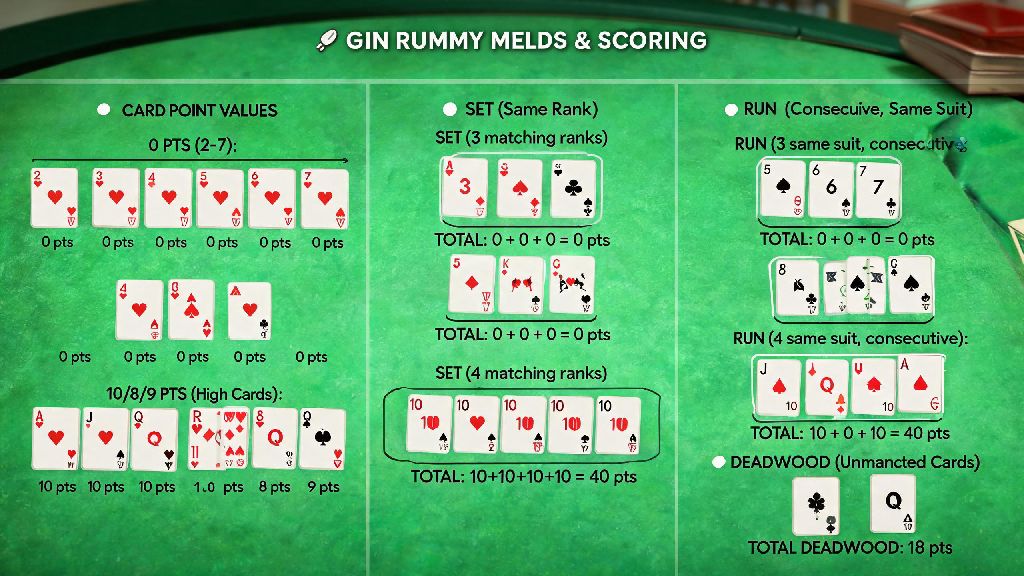
Before you start tallying scores for any round, you need to memorize the fixed point values for every card in the deck. These values never change across standard gin rummy rule sets, so learning them once will serve you for every future game. Numbered cards 2 through 10 are worth their face value in points, so a 7 of clubs is worth 7 points, a 3 of diamonds is worth 3 points, and so on. Face cards (jack, queen, king) all carry a 10-point value each, no matter what suit they are. Aces are always worth 1 point in standard gin rummy, there are no high-ace rules here like you might see in poker or other rummy variants.
Your total score for each round is tied directly to your deadwood count, which is the total point value of all cards you hold that are not part of a valid meld. Melds are either sets (three or four cards of the same rank, like three 5s) or runs (three or more consecutive cards of the same suit, like 4,5,6 of hearts). The goal of every round is to get your deadwood count low enough to knock, or eliminate it entirely to call gin. Keep these core rules in mind as you calculate scores:
I’ve seen new players waste 10 minutes arguing over whether a 10, jack, queen, ace counts as a valid run, but it doesn’t. Aces only count as low cards, so the highest valid run that includes an ace is ace, 2, 3 of the same suit. Any run that wraps around from king to ace is invalid, and those cards will count towards your deadwood total.
How Do You Score Gin Rummy for Standard Casual Play
Most casual home games follow the same core scoring flow, with small adjustments to bonus amounts that players agree on before starting the game. The scoring process kicks off when one player knocks, meaning they have a deadwood count of 10 points or lower and choose to end the round. Both players lay down all their melds first, so everyone can see which cards count towards valid combinations.
The non-knocking player then gets the chance to lay off any of their deadwood cards onto the knocker’s melds if they fit. For example, if the knocker has a set of three 8s, the non-knocker can add their own 8 to that set to remove it from their deadwood count. Once all eligible layoffs are made, both players calculate their final deadwood totals. The knocking player only wins points if their deadwood total is lower than their opponent’s after layoffs.
The winning player earns points equal to the difference between the two players’ deadwood totals. If Player A knocks with 6 deadwood, and Player B ends with 18 deadwood after layoffs, Player A earns 12 points for the round. If you’re wondering how do you score gin rummy for tournament play, the core steps are identical to casual play, just with fixed bonus amounts that don’t vary between games.
So what happens if the non-knocking player has a lower deadwood count than the knocker? That’s called an undercut, and we cover that special scoring rule next.
Special Scoring Rules for Undercuts, Gin, and Big Gin
Standard gin rummy has three special scoring scenarios that change how you calculate final points, and they come up more often than you might think. First is the undercut, which happens when the non-knocking player has a deadwood total equal to or lower than the knocker’s after layoffs. In this case, the non-knocking player wins the round instead of the knocker, and earns the difference between the two deadwood totals plus a flat undercut bonus. Undercut bonuses are standard across almost all official gin rummy rule sets, usually set at 25 points for casual play and 25 or 30 for tournament play.
Second is the gin scenario, which happens when a player has zero deadwood, meaning all 10 of their cards are part of valid melds. When a player calls gin, the round ends immediately, and the non-knocking player does not get to lay off any of their deadwood cards. Opponents cannot lay off any cards when the other player calls gin, so you don’t get to reduce your deadwood in that scenario. The player who called gin earns 25 points plus the full total of their opponent’s deadwood, no adjustments allowed.
Third is the big gin scenario, a less common but high-scoring situation where a player has zero deadwood and holds 11 total cards (meaning they picked up their final draw card and all 11 fit into valid melds). Big gin comes with a higher bonus, usually 31 points plus the full total of the opponent’s deadwood. Many new players try to go for gin every round, but knocking early when you have low deadwood can help you accumulate small points consistently, as long as you don’t get undercut. The risk of an undercut is the biggest downside to knocking early, so weigh that before you end the round.
Common Gin Rummy Scoring Mistakes to Avoid
Even players who know the basic scoring rules often make small mistakes that throw off final scores and lead to arguments mid-game. The most common mistake is counting aces as 11 points, a habit many people bring over from poker or blackjack. Always double-check ace values before calculating deadwood, because a single ace counted as 11 instead of 1 can swing a score by 10 points or more.
Another frequent mistake is forgetting to let the non-knocking player lay off their cards after a knock. I once played a round where I knocked with 7 deadwood, and my opponent had 19 deadwood, but they were able to lay off 9 points worth of cards onto my melds, bringing their total down to 10. If I had skipped the layoff step, I would have earned 12 points instead of the 3 I actually won. Always let the non-knocking player lay off eligible cards before calculating final deadwood totals to keep scores fair.
Many players also forget to agree on bonus amounts before starting a game. Some home groups use a 20-point gin bonus, others use 25, and some set undercut bonuses as high as 30 points. Taking 30 seconds to confirm these numbers before you deal the first hand will save you a lot of frustration later. Always confirm run validity before counting cards as melded, too. As we mentioned earlier, aces can only be low in runs, so queen, king, ace is not a valid run, and those cards will count as deadwood.
One last mistake to watch for is miscalculating deadwood after layoffs. It’s easy to miss a card that fits into an opponent’s meld, so take your time when laying down your cards at the end of a round. A single missed layoff can change who wins the round entirely.
Scoring gin rummy doesn’t have to be a confusing process that leads to fights over point counts or rule technicalities. Once you memorize the core card values and special bonus rules, you’ll be able to tally scores quickly and fairly for every round, no matter if you’re playing at home with friends or joining a local tournament. Taking time to double-check melds, deadwood counts, and layoff eligibility will make every game more fun for everyone involved. Now that you know how do you score gin rummy correctly, you can grab a deck of cards and start playing your next round with total confidence.