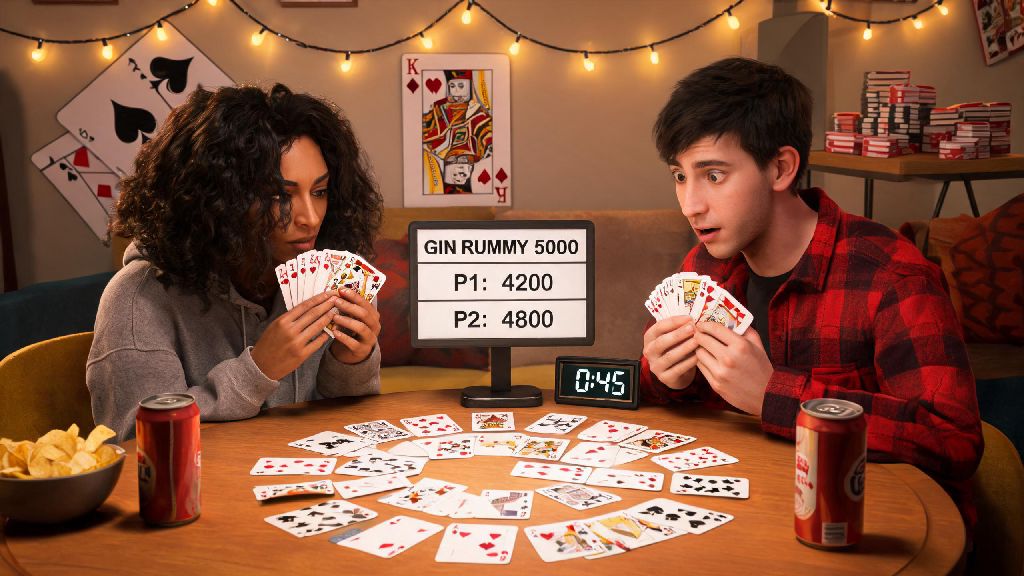
If you’ve grown bored of standard gin rummy and want something with higher stakes, faster rounds, and more room for bold plays, you’re probably curious how to play gin rummy 5000. This variant takes the classic card game you know and twists the scoring and win conditions to keep every round exciting, even if you’ve been playing rummy for decades. I’ve been testing this variant with my weekly game night crew for two years, and it’s now our go-to when we want to mix up our usual rotation without learning an entirely new card game. It’s easy to pick up, but has enough nuance that you’ll still find new strategies months after you start playing.
Core Rules for How to Play Gin Rummy 5000
The base rules will feel familiar if you’ve played standard gin rummy, with a few key tweaks to accommodate the higher scoring target. You only need two players and a standard 52-card deck to play, no extra equipment required. Aces are worth 1 point, face cards are worth 10 points, and number cards match their printed value. The dealer passes out 10 cards to each player, places the remaining stack face down as the draw pile, and flips the top card over to start the discard pile.
Turns follow the same structure as standard gin: you draw one card from either the top of the discard pile or the draw pile, then discard one card from your hand to end your turn. The goal of each round is to build sets (three or four cards of the same rank) and runs (three or more consecutive cards of the same suit) to reduce your “deadwood” – unmatched cards that don’t fit into any set or run. All round scores are multiplied by 10 to help you reach the 5000 point match target faster.
You can only knock at the start of your turn, right after you draw a card, if your total deadwood is 10 points or less. If you have no deadwood at all, that counts as a gin, and you get a larger bonus for the round. If the draw pile runs out before anyone knocks, the round ends with no points awarded, and you reshuffle the deck to redeal. This multiplier is what sets gin rummy 5000 apart from every other gin variant, and it’s why the game feels so much faster and higher-stakes.
Official Gin Rummy 5000 Scoring Breakdown
Scoring is where most new players get tripped up at first, but it’s simple once you get the hang of the multiplier rule. After a player knocks, both players lay down their sets, runs, and deadwood to calculate totals. The player with the lower deadwood total wins the round, and gets points based on the difference and any applicable bonuses. We keep a printed copy of this bonus list on our game night table to avoid arguments mid-round:
You don’t have to stop playing when someone hits 5000 mid-round – the round has to finish first, and if both players end up over 5000 after scoring, the one with the higher total wins the match. A lot of groups add custom house rules for extra bonuses, like extra points for a gin on your first turn, but it’s best to stick to the official scoring first until everyone is comfortable with the base game. I always bring a small pocket calculator to game night to avoid multiplication mistakes that can throw off the entire match.
Beginner-Friendly Strategies to Win More Rounds
A lot of new players make the mistake of chasing gin every round, but that’s rarely the best move in this variant. The 10x multiplier means even small, consistent knock wins add up much faster than rare gin bonuses, especially if you risk an underknock while waiting for one last card. Don’t hold onto high-value deadwood for more than two turns – a king or queen that doesn’t fit into a set or run will cost you 10 points per card, which turns into 100 points if your opponent knocks before you can use it.
Pay close attention to what your opponent picks up from the discard pile to guess what sets or runs they are building. If they pick up a 7 of spades early in the round, they are almost certainly building a run or set that includes that card, so you don’t want to hold onto a 5 or 6 of spades as deadwood if you can discard it safely. That’s one of the biggest differences between standard gin and gin rummy 5000 – small losses hit way harder, so you have to balance risk and reward more carefully.
Discard high-value cards first if they don’t fit into any potential sets or runs to cut your potential losses if your opponent knocks early. I’ve lost full matches before because I held onto a king for three turns hoping to draw a pair, only for my opponent to knock and leave me with 18 deadwood. If you have a choice between knocking with 8 deadwood or waiting one more turn to try for gin, calculate the risk first: if your opponent likely has 15 deadwood, you’ll get 70 points for knocking now, but if you wait and they knock first, you could lose 170 points total. Most of the time, taking the small guaranteed win is the smarter play.
Common Gin Rummy 5000 Mistakes to Avoid
Even players who know standard gin really well can slip up with the 5000 variant because of the scoring multiplier, and small mistakes can cost you the entire match. The most common mistake I see is forgetting to multiply scores by 10 at the end of the round. I’ve seen groups argue for 10 minutes because someone added 25 points for gin instead of 250, so always double check your math before adding points to the total scoreboard.
Another frequent mistake is knocking too early with 10 deadwood when you have reason to think your opponent has a lower total. Always try to guess your opponent’s deadwood total before you knock – you can do this by tracking what cards they pick up and discard. For example, if they picked up two face cards in the last three turns, they probably have them in a set, so their deadwood is lower than you might assume. If you knock with 10 deadwood and they only have 7, you’ll lose 130 points total, which is a huge hit to your path to 5000.
A lot of standard gin players are used to holding onto high cards for a few extra turns, but that’s a terrible habit in gin rummy 5000, where a 10 point difference becomes 100 points instantly. Don’t ignore the discard pile to draw random cards from the stock either – the discard pile gives you guaranteed information about what your opponent isn’t using, while the stock is a total gamble. I only draw from the stock if the discard pile card doesn’t fit any of my sets or runs, no exceptions. Playing too defensively will also hurt you in the long run: you don’t have to win every round, but you do need to accumulate points consistently to hit 5000 first.
Once you get the hang of the scoring multiplier and adjusted win conditions, you’ll find how to play gin rummy 5000 is way more dynamic than standard gin, and perfect for both short 20-minute games and longer game night marathons. Start with the official rules first, then add your own house rules as you get comfortable – my crew added a rule where a “perfect gin” (gin on your first turn) gives you a 500 point bonus, and it makes every first round feel a little more exciting. If you’re looking for a new rummy variant to add to your rotation, this one is well worth the small learning curve.