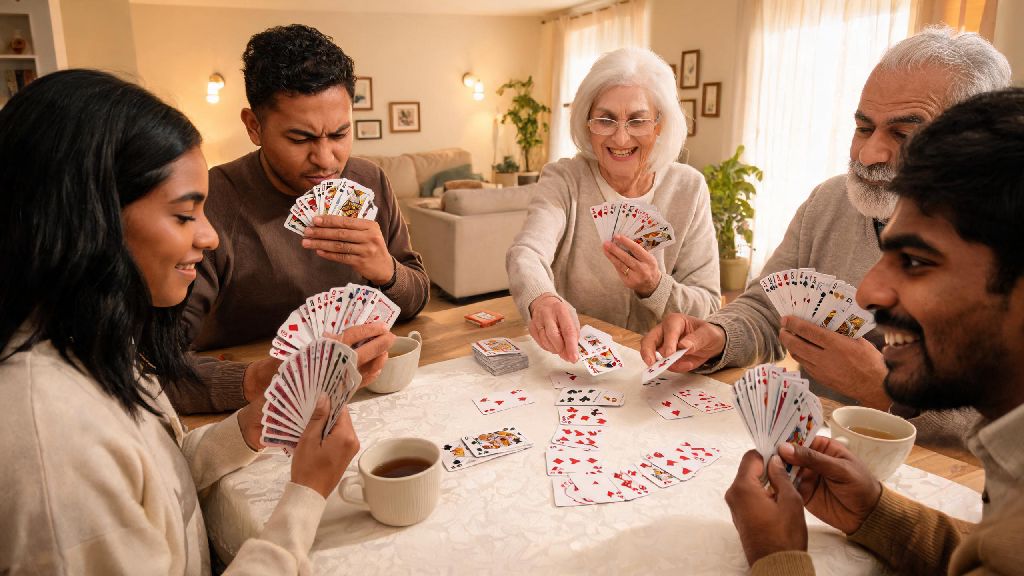
If you’ve been seeing rummy pop up everywhere from family game nights to 2026’s most popular casual gaming events, you’re not alone. This classic card game is easy to pick up, endlessly replayable, and works for groups of 2 to 6 players of almost all ages. If you’re ready to jump in, we’re breaking down exactly how to play rummy game with cards, no prior experience required. We’ll skip the overly complicated jargon and stick to standard 13-card rummy rules, the most widely played version across the U.S. and most of Europe today.
What You Need to Set Up and Play Rummy Game with Cards in 2026
You don’t need any fancy equipment to play, just a standard card deck and a flat surface to play on. If you’re learning how to play rummy game with cards for the first time, we recommend sticking to the 2-player version first, so you can get used to the turn flow without keeping track of too many other players’ moves. The only thing that changes based on group size is the number of decks you use.
For 2 to 3 players, use one standard 52-card deck plus 2 printed jokers. For 4 to 6 players, use two standard 52-card decks plus 4 printed jokers. The goal of every round is to arrange all 13 of your dealt cards into valid combinations called melds, then discard your final card to declare a win. Before the round starts, the dealer will flip the top card of the remaining draw pile to set the wild card for the round – any card of that rank can be used as a substitute joker for the rest of the game.
Core Rules for Valid Melds in Standard Rummy
One of the most confusing parts of learning how to play rummy game with cards for new players is telling the difference between valid and invalid melds, so we’ll break that down clearly below. All melds have to have at least 3 cards, and you need at least one pure sequence to be eligible to declare a win, no exceptions. There are three types of valid melds you can make.
A pure sequence is 3 or more consecutive cards of the same suit, with no jokers used. For example, 5,6,7 of spades is a valid pure sequence, but 5, joker,7 of spades is not. An impure sequence is 3 or more consecutive cards of the same suit, with up to one joker substituting a missing card. The third type of meld is a set, which is 3 or 4 cards of the same rank from different suits, with up to one joker allowed per set. For example, 10 of hearts, 10 of diamonds, 10 of clubs is a valid set, and adding a joker to make 4 cards is also allowed.
Step-by-Step Turn Flow for Every Rummy Round
Turns are very simple once you get the hang of them, and they follow the same structure every time, no matter how many players you have. On your turn, you first draw one card: you can either pick the top face-down card from the draw pile, or the top face-up card from the discard pile if it helps you build a meld. After you draw, you have to discard one card from your hand face-up on the discard pile to end your turn.
Most new players make small, avoidable mistakes on their turns that cost them points, or even the round. Some of the most common mistakes you’ll see in 2026 casual play include:
Quick 2026 Rummy Tips to Win More Casual Games
You don’t need to memorize complicated strategies to win most casual rummy games, just a few small tweaks to your play style will make a huge difference. First, always prioritize building your pure sequence before anything else. You can have all the other melds perfect, but if you don’t have a pure sequence, you can’t declare a win, so this is non-negotiable.
Don’t hold onto high value cards (K, Q, J, Ace) for too long if you can’t form a meld with them quickly. If another player declares first, you get points equal to the value of all unmelded cards in your hand, so high value cards will cost you way more than low number cards if you lose. Pay attention to what other players are discarding too – that tells you what melds they’re working on. For example, if a player discards a 7 of hearts, they probably don’t need any hearts around that rank, so you can safely hold onto those if you’re building a sequence.
You can use a printed joker or a wild card (selected at the start of each round) for any missing card in impure sequences or sets, but they can never count towards a pure sequence. If you’re just starting out learning how to play rummy game with cards, don’t worry about memorizing all the pro strategies right away – focus on getting the core rules down first, and the rest will come with practice.
Rummy is one of those rare games that’s just as fun for first-time players as it is for lifelong fans, and there’s no better time to pick it up than 2026, with so many casual groups and local tournaments popping up across the country. Once you get the hang of how to play rummy game with cards, you can start exploring fun variants like gin rummy, rummy 500, or Indian rummy to mix up your game nights. Don’t stress if you lose your first few rounds – the best way to get better is to play as often as you can, and adjust your strategy as you learn what works for your play style.