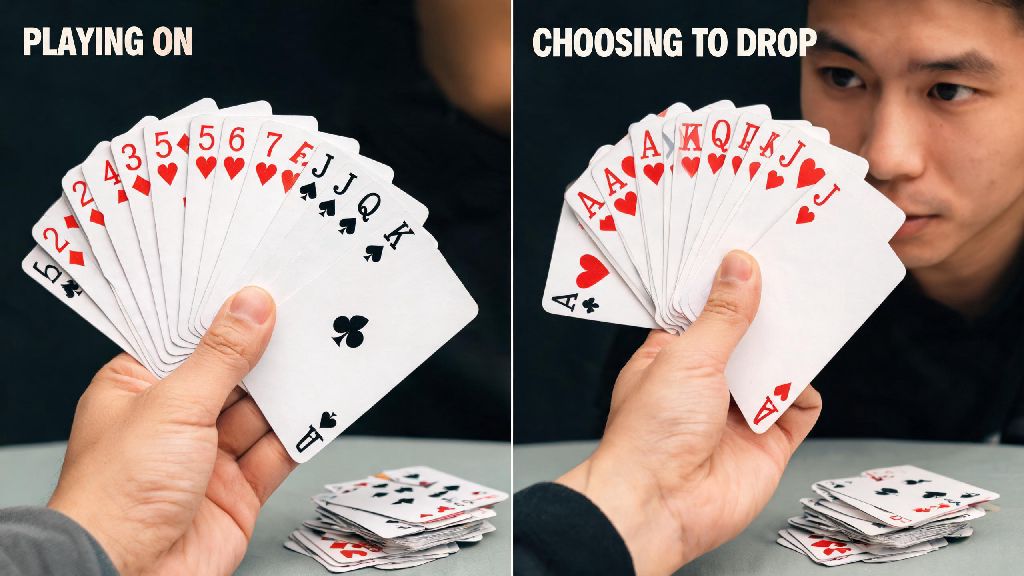
You’re three rounds into a casual rummy game, staring at a hand full of unpaired kings, queens, and random number cards with no clear path to a sequence. Every draw from the pile gives you more junk, and you notice your opponent is discarding low-value cards like they already have most of their combinations built. Most players in this spot will stubbornly play on, hoping for a miracle draw that never comes, and end up losing a mountain of points. Knowing when to drop in rummy is one of the most underrated, high-impact skills you can build, no matter if you play casually with friends or compete in paid online tournaments. It’s not a sign of weakness – it’s a sign you’re playing the long game to minimize losses and maximize wins over time.
When to Drop in Rummy: Common Scenarios That Warrant a Fold
If you’re still on the fence about when to drop in rummy, these scenarios will make the call easy for you. First, if your opening hand has four or more unconnected high-point cards (jacks, queens, kings, aces) with no matching pairs or adjacent numbers, you’re already at a huge disadvantage. The odds of drawing the exact cards you need to build sequences are less than 15% in most 2-6 player games, so you’re better off cutting your losses early. Second, if you’ve gone three full rounds of drawing and still don’t have a pure sequence (a sequence of three or more same-suit cards with no jokers), you can’t legally win the hand anyway. Holding on any longer just means you risk a higher point penalty later. Third, if your opponent is discarding only low-value cards and picking up almost every card you throw away, they’re almost certainly two or fewer moves away from declaring a win. If you’re still half a dozen cards away from a valid hand, dropping is the smartest move.
It’s also important to factor in the standard drop penalties for your game variant. Most rummy games charge 20 points for a first drop (before you make your first draw) and 40 points for a middle drop (after you’ve started playing). If the total points of your ungrouped high cards are already over 50, you’ll almost always save points by dropping instead of playing through a loss.
Before you confirm a drop, ask yourself these 3 quick questions:
If you answered no to the first question and yes to either of the other two, you should drop immediately. There’s no shame in folding a bad hand to save your points for a better deal later.
The Hidden Benefits of Dropping Bad Hands Early
A lot of new players avoid dropping because they see it as an automatic loss, but that’s a short-sighted way to look at the game. Rummy is all about cumulative wins over multiple hands, not winning every single hand you’re dealt. For example, if you drop 10 bad hands at 20 points each, you lose 200 points total. If you’d played all 10 hands and lost an average of 70 points each, you’d lose 700 points – that’s a 500-point difference from just making smart drop choices.
Dropping also saves you mental energy you can put toward more winnable hands. Trying to force a garbage hand into a valid set takes a lot of focus, and it’s easy to miss obvious opportunities in later hands because you’re still frustrated about the bad deal you stuck with earlier. Cash game rummy players who drop strategically win 30% more often over 100 game sessions, according to recent player data from popular online rummy platforms. That’s not a small difference – it’s the gap between playing for fun and playing for consistent profits.
It can also throw off your opponent’s strategy. If they’ve been tracking your discards and assuming you’re building a specific set, your unexpected drop will make them second-guess their own hand choices. I’ve seen players fold a bad hand right as their opponent was about to discard a key card they needed, forcing the opponent to hold onto a high-point card they’d planned to get rid of. That small disruption can lead to bigger wins for you in the very next hand.
Mistakes to Avoid When Deciding to Drop
If you’re still unsure when to drop in rummy, avoid these common missteps that cost players thousands of points every year. The biggest mistake is dropping out of immediate frustration. If you get one bad draw on your first turn, don’t fold right away. Wait for at least one more draw, or check if you can rearrange the cards you already have to form the start of a sequence. I’ve had opening hands that looked like total garbage, only to draw two perfect cards on the next two turns and win the hand by a wide margin.
The sunk cost fallacy is the number one reason players lose more points than necessary in rummy. That’s the idea that because you’ve already invested time or points into a hand, you have to keep playing it through. That’s never true. The points you’ve already risked don’t matter – the only thing that matters is whether dropping now will save you more points than playing on. If you’re facing a 40-point middle drop penalty, but you’d lose 80 points if you finish the hand and lose, dropping still saves you 40 points no matter how many rounds you’ve already played.
Another common mistake is dropping when you already have a pure sequence. If you have a valid pure sequence, even if the rest of your hand is messy, you can easily discard high-point unpaired cards to reduce your total loss if you don’t win. Dropping in this spot wastes the advantage you already have, and you’ll almost always pay more in penalties than you would if you just played through and discarded your high cards. Never drop if you have already accumulated 80+ points in a pool rummy game, either. Most pool rummy games cap the maximum loss per hand at 80 points, so dropping would cost you 20-40 points for no reason – you might as well try to win, since you’ll lose the same amount if you finish last anyway.
How to Adjust Your Drop Strategy for Different Rummy Formats
Your drop rules will change slightly depending on what type of rummy you’re playing, so it’s important to adjust your approach for each format. For points rummy, where each hand is independent and you pay out points immediately after each round, you can afford to drop more often. Points rummy players should drop roughly 30-35% of all opening hands that don't show clear winning potential. The low penalty for early drops means you can skip bad hands without hurting your overall bankroll, and wait for deals that give you a real shot at winning.
For deals rummy, where you play a fixed number of hands and total your points at the end, you can be a little more patient with borderline hands. Since each hand counts equally toward your final score, you don’t want to give up points unnecessarily if you have a shot at turning a mediocre hand into a winning one. Still, if you don’t have a pure sequence after three draws, drop immediately – the risk of a big loss is too high to justify holding on.
For knockout rummy tournaments, dropping is even more critical. A single big loss can knock you out of the tournament entirely, so you want to drop any hand that doesn’t have a clear path to victory in the early rounds. As you get closer to the final table, you can be a little more aggressive with borderline hands, but you still should never play a hand that has no pure sequence after three draws. In 6-player games, you’ll also want to drop more often than you would in 2-player games – the more players there are, the higher the chance someone else will finish their hand early before you have time to build yours.
At the end of the day, rummy is a game of skill as much as it is luck, and knowing when to drop in rummy is a skill that separates casual players from consistent winners. You don’t have to win every hand to come out ahead, you just have to make smarter choices more often than your opponents. Next time you’re dealt a messy hand, take 10 seconds to weigh your options instead of automatically playing on or folding out of frustration. Over time, those small smart choices will add up to bigger wins, fewer big losses, and a lot more fun every time you sit down to play.