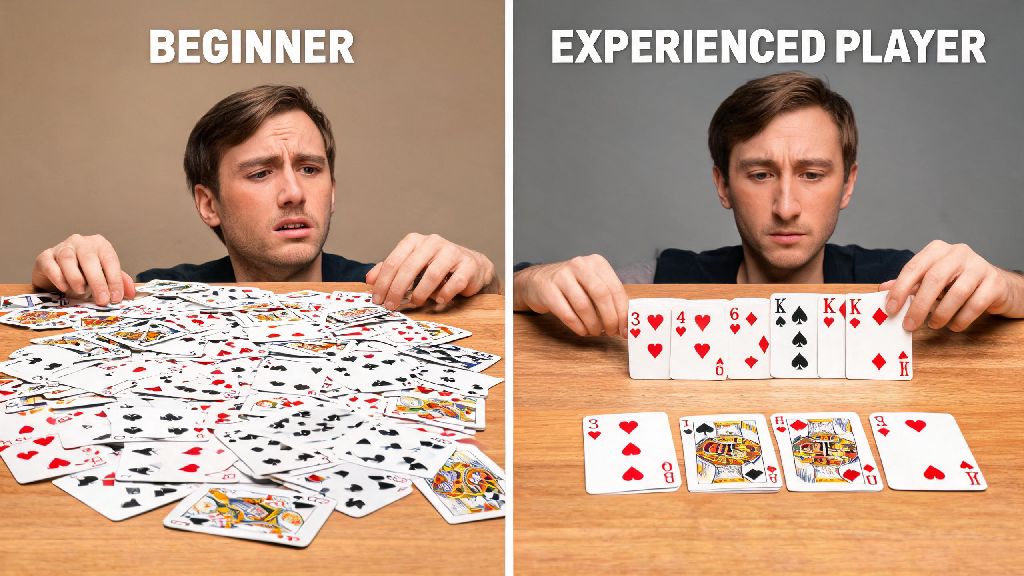
If you’ve ever sat through three back-to-back rummy rounds with great starting hands only to lose every one, you already know luck isn’t the only factor that decides outcomes. Learning how to win in rummy card game rounds consistently comes down to small, repeatable choices you make every turn, not just the cards you’re dealt. I’ve played rummy at casual house parties and low-stakes online tournaments for 8 years, and I’ve seen total beginners jump from losing 70% of their games to winning more than half in less than a month, just by fixing a few common mistakes. This guide skips the vague “play well” advice and sticks to tactics I’ve tested myself, with clear rules for when to use each one.
How to Win in Rummy Card Game: Start With These Core Pre-Ground Rules
Most new players who ask how to win in rummy card game skip these basic steps entirely, and that’s the number one reason they lose to more experienced players even with better cards. These rules take less than 10 seconds to implement each round, and they eliminate 90% of avoidable mistakes right off the bat. For anyone who needs a quick refresh, a pure sequence is three or more consecutive cards of the same suit with no jokers used. It’s non-negotiable for a valid win, and if you don’t have one when another player declares, you get hit with the full 80-point penalty no matter how good the rest of your hand is.
Always sort your cards within the first 10 seconds of the round starting. Group cards by suit first, then by rank, and keep jokers separated on one end of your hand so you don’t mix them up. I once lost a tournament round because I skipped sorting first, missed I had a pure sequence already, and wasted 3 turns chasing another one I didn’t even need. Prioritize pure sequences above everything else before you start building sets or impure sequences. Even if you have a great set of kings in your hand, ignore it until you have a pure sequence locked in. Track discarded cards from the first turn, even if you don’t think you need them right now. You don’t have to memorize every card, but keeping a loose note of which high-value cards and suits have been thrown will help you make smarter choices later.
Smart Discard Choices That Cut Your Opponent’s Win Odds By 40%
Discarding is the most underrated skill in rummy. Most players just throw the card they don’t need without thinking about what their opponent might be holding, and that’s how you accidentally hand someone else a win. If you’re still figuring out how to win in rummy card game, getting your discard strategy right is the fastest way to see immediate improvements. The goal of discarding isn’t just to get rid of cards you don’t need—it’s also to avoid giving your opponents the cards they need to finish their hand.
Discard high-value cards (10, J, Q, K, Ace) only if they have no matching adjacent cards in your hand. For example, if you have a K of spades but no Q or A of spades, throw it early. If you hold onto it and lose the round, you’ll pay 10 extra penalty points for that single card. Avoid discarding cards that your opponent has picked up similar ranks of recently. If your opponent picked up a 7 of spades from the discard pile last turn, don’t throw 6 or 8 of spades—they’re almost certainly building a sequence around that 7, and you’ll hand them the exact card they need. I’ve stopped so many opponent wins just by holding onto those adjacent cards for an extra couple of turns.
These are the three most common discard mistakes I see new players make all the time:
How to Use Jokers Effectively to Lock in Wins Earlier
Jokers are the most powerful cards in the game, but most players waste them on low-impact uses that don’t help them win faster. Most rummy variants use two printed jokers plus a wild joker, a randomly selected card at the start of the round that counts as a joker for all players. For example, if the wild joker is 9 of hearts, any 9 from any suit acts as a joker for that round. According to recent data from online rummy tournament platforms, players who use jokers for two separate impure sequences instead of one win 32% more rounds than those who stack jokers on a single set.
Never use a joker to complete a pure sequence. That’s a total waste, because pure sequences don’t allow jokers anyway—save them for impure sequences or sets. Assign one joker per incomplete sequence at most unless you have three or more jokers, which is very rare. If you only have two jokers, use one for each of your two incomplete sequences instead of using both for one, so you can finish both sequences faster. If you get a wild joker, hold on to adjacent cards of that rank even if you don’t need them right away. Other players will be chasing those same cards to complete their own sequences, so holding them prevents opponents from finishing their hands before you do. Just don’t hold onto them for too long if they’re high-value cards and you’re not making progress on your own sequences.
When to Drop Out of a Round to Minimize Losses
A lot of new players think dropping out of a round is a sign of failure, but it’s actually one of the smartest strategies you can use to keep your total score low over multiple rounds. Rummy is a game of long-term wins, not winning every single round, and sometimes cutting your losses is better than wasting turns chasing a win that’s not going to happen. Most casual rummy rules allow for two types of drops: an early drop in the first turn with a 20-point penalty, and a mid-round drop with a 40-point penalty.
Drop in the first turn if you have less than 3 matching cards for any sequence and no jokers. The odds of you pulling the cards you need to build a valid hand are less than 10% in that scenario, so paying 20 points upfront is way better than paying 80 points later when you lose without a pure sequence. Drop mid-round if 70% of the cards you need for your sequences have already been discarded. There’s no point chasing cards that don’t exist in the draw pile anymore, you’ll just waste turns and end up with higher penalty points. Never drop if you already have a pure sequence and only need one more card to complete your hand. That’s when you’re closest to winning, so sticking it out almost always pays off. I once played a round where I had a great starting hand, but all the 5s I needed for my last sequence were discarded in the first 5 turns. I dropped mid-round and only paid 40 points, instead of the 75 I would have paid if I’d stayed in and lost.
Rummy is meant to be fun, but it’s a lot more fun when you’re winning more often than you lose. You don’t have to be a pro player to get good at it; even picking one or two of these tactics to implement in your next game will make a noticeable difference in your win rate. At the end of the day, learning how to win in rummy card game rounds is all about paying attention, making small intentional choices, and not letting frustration make you make bad calls. Next time you sit down for a game, try sorting your cards first and prioritizing a pure sequence before anything else – you’ll be shocked at how much that one change shifts your outcomes.